Application
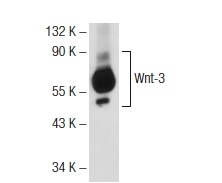
Western blot analysis of Wnt-3 expression in rat testis tissue extract.| Product Name | Wnt-3 Antibody (H-70) |
|---|---|
| Antibody Type | Primary Antibodies |
| Antigen Alias | epitope corresponding to amino acids 241-310 mapping near the C-terminus of Wnt-3a of human origin |
| Modification Notes | The Wnt gene family encodes secreted signaling molecules that bind to frizzled receptors and influence oncogenesis and developmental processes, including regulation of cell fate and patterning during embryogenesis (1). The Wnt family has two functional classes according to their biological activities; Wnts that signal through a Wnt-1/wingless pathway by stabilizing cytoplasmic beta-catenin, and Wnts that stimulate intracellular Ca2+ release and activate two kinases, CamKII and PKC, in a G protein-dependent manner (1,2). Wnt-3 is present during development of the cerebellum and is restricted to the Purkinje cell layer in the adult (3,4). In motoneurons, Wnt-3 is a retrograde signal that controls terminal branching of muscle afferents (5). Human Wnt-3 is 98% homologous to mouse Wnt-3 protein and 84% homologous to human Wnt-3a protein (6). The human Wnt-3 gene clusters with the Wnt-15 gene at chromosome 17q21 (6). |
| Clonality | Polyclonal |
|---|---|
| Isotype | IgG |
| Host Species | Rabbit |
| Tested Applications | WBIPIFELISA |
| recommended for detection of precursor and mature Wnt-3 and Wnt-3a of mouse, rat and human origin by WB, IP, IF and ELISA also reactive with additional species, including equine, canine, bovine, porcine and avian: |
|
| Species Reactivity | HumanMouseRat |
| Concentration | 1mg/ml |
| Purification | Affinity purified |
| Alternative Names | epitope corresponding to amino acids 241-310 mapping near the C-terminus of Wnt-3a of human origin |
|---|---|
| Tissue Specificity | epitope corresponding to amino acids 241-310 mapping near the C-terminus of Wnt-3a of human origin |
| Entrez Gene | 7473 |
|---|
Application
Western blot analysis of Wnt-3 expression in rat testis tissue extract.| Application Notes | recommended for detection of precursor and mature Wnt-3 and Wnt-3a of mouse, rat and human origin by WB, IP, IF and ELISA also reactive with additional species, including equine, canine, bovine, porcine and avian: |
|---|
| Form | Liquid |
|---|---|
| Storage Instructions | For short-term storage, store at 4° C. For long-term storage, aliquot and store at -20ºC or below. Avoid multiple freeze-thaw cycles. |
| Storage Buffer | phosphate buffered saline , pH 7.4, 150mM NaCl, 0.02% sodium azide and 50% glycerol. |


