Application
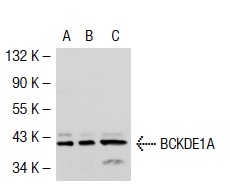
Western blot analysis of BCKDE1A expression in non-transfected 293T: (A), mouse BCKDE1A transfected 293T: (B) and HeLa (C) whole cell lysates.| Product Name | BCKDE1A Antibody (H-300) |
|---|---|
| Antibody Type | Primary Antibodies |
| Antigen Alias | epitope corresponding to amino acids 47-346 mapping near the N-terminus of BCKDE1A of human origin |
| Modification Notes | BCKDE1A (branched-chain å-keto acid dehydrogenase E1 component å chain), also known as BCKDHA or 2-oxoisovalerate dehydrogenase subunit å, is part of the inner mitochondrial membrane complex involved in the catabolism of the branched-chain amino acids. This complex consists of multiple copies of three catalytic components: BCKDE1, DBT and DLD. It is responsible for catalyzing the conversion of å-keto acids to acyl-CoA and CO(2). BCKDE1A is the å chain component of BCKDE1. BCKDE1 is heterotetrameric, consisting of two å chains and two ∫ chains. A mutation in BCKDE1A can result in a deficiency of the properly assembled BCKDH complex. A deficiency of this enzyme leads to an accumulation of branched-chain amino acids in the blood an urine. This metabolic disorder is called type IA maple syrup urine disease (MSUD). |
| Clonality | Polyclonal |
|---|---|
| Isotype | IgG |
| Host Species | Rabbit |
| Tested Applications | WBIPIFELISA |
| recommended for detection of BCKDE1A of mouse, rat and human origin by WB, IP, IF and ELISA also reactive with additional species, including equine, canine, bovine, porcine and avian: |
|
| Species Reactivity | HumanMouseRat |
| Concentration | 1mg/ml |
| Purification | Affinity purified |
| Alternative Names | epitope corresponding to amino acids 47-346 mapping near the N-terminus of BCKDE1A of human origin |
|---|---|
| Tissue Specificity | epitope corresponding to amino acids 47-346 mapping near the N-terminus of BCKDE1A of human origin |
| Entrez Gene | 593 |
|---|
Application
Western blot analysis of BCKDE1A expression in non-transfected 293T: (A), mouse BCKDE1A transfected 293T: (B) and HeLa (C) whole cell lysates.| Application Notes | recommended for detection of BCKDE1A of mouse, rat and human origin by WB, IP, IF and ELISA also reactive with additional species, including equine, canine, bovine, porcine and avian: |
|---|
| Form | Liquid |
|---|---|
| Storage Instructions | For short-term storage, store at 4° C. For long-term storage, aliquot and store at -20ºC or below. Avoid multiple freeze-thaw cycles. |
| Storage Buffer | phosphate buffered saline , pH 7.4, 150mM NaCl, 0.02% sodium azide and 50% glycerol. |


