Application
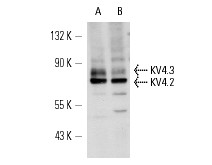
Western blot analysis of KV4.2/4.3 expression in mouse (A) and rat (B) brain tissue extracts.| Product Name | KV4.2/4.3 Antibody (H-225) |
|---|---|
| Antibody Type | Primary Antibodies |
| Antigen Alias | epitope corresponding to amino acids 406-630 mapping within a C-terminal cytoplasmic domain of KV4.2 of human origin |
| Modification Notes | Voltage-gated K+ channels in the plasma membrane control the repolarization and the frequency of action potentials in neurons, muscles, and other excitable cells. The KV gene family encodes more than 30 genes that comprise the subunits of the K+ channels, and they vary in their gating and permeation properties, subcellular distribution, and expression patterns. Functional KV channels assemble as tetramers consisting of pore-forming å-subunits (KVå), which include the KV1, KV2, KV3, and KV4 proteins, and accessory or KV∫ subunits that modify the gating properties of the coexpressed KVå subunits. Differences exist in the patterns of trafficking, biosynthetic processing and surface expression of the major KV1 subunits (KV1.1, KV1.2, KV1.4, KV1.5 and KV1.6) expressed in rat and human brain, suggesting that the individual protein subunits are highly regulated to control for the assembly and formation of functional neuronal channels. |
| Clonality | Polyclonal |
|---|---|
| Isotype | IgG |
| Host Species | Rabbit |
| Tested Applications | WBIPIFELISA |
| recommended for detection of KV4.2, KV4.3, and, to a lesser extent, KV4.1 of mouse, rat and human origin by WB, IP, IF and ELISA also reactive with additional species, including equine, canine, bovine, porcine and avian: |
|
| Species Reactivity | HumanMouseRat |
| Concentration | 1mg/ml |
| Purification | Affinity purified |
| Alternative Names | epitope corresponding to amino acids 406-630 mapping within a C-terminal cytoplasmic domain of KV4.2 of human origin |
|---|---|
| Tissue Specificity | epitope corresponding to amino acids 406-630 mapping within a C-terminal cytoplasmic domain of KV4.2 of human origin |
| Entrez Gene | 3751 |
|---|
Application
Western blot analysis of KV4.2/4.3 expression in mouse (A) and rat (B) brain tissue extracts.| Application Notes | recommended for detection of KV4.2, KV4.3, and, to a lesser extent, KV4.1 of mouse, rat and human origin by WB, IP, IF and ELISA also reactive with additional species, including equine, canine, bovine, porcine and avian: |
|---|
| Form | Liquid |
|---|---|
| Storage Instructions | For short-term storage, store at 4° C. For long-term storage, aliquot and store at -20ºC or below. Avoid multiple freeze-thaw cycles. |
| Storage Buffer | phosphate buffered saline , pH 7.4, 150mM NaCl, 0.02% sodium azide and 50% glycerol. |


