Application
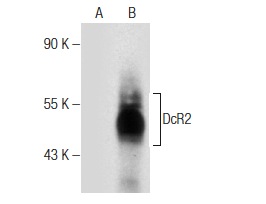
Western blot analysis of DcR2 expression in non-transfected: (A) and human DcR2 transfected: (B) 293T whole cell lysates.| Product Name | DcR2 Antibody (H-52) |
|---|---|
| Antibody Type | Primary Antibodies |
| Antigen Alias | epitope corresponding to amino acids 335-386 mapping within a C-terminal cytoplasmic domain of DcR2 of human origin |
| Modification Notes | Tumor necrosis factor (TNF) is a pleiotropic cytokine whose function is mediated by two distinct cell surface receptors, designated TNF-R1 and TNF-R2, which are expressed on most cell types. TNF function is primarily mediated through TNF-R1 signaling. Both receptors belong to the growing TNF receptor superfamily which includes FAS antigen and CD40. TNF-R1 contains a cytoplasmic motif, termed the “death domain,” that has been found to be necessary for the transduction of the apoptotic signal. The death domain is also found in several other receptors, including FAS, DR2 (or TRUNDD), DR3 (death receptor 3), DR4, DR5 and DR6. TRUNDD, DR4 and DR5 are receptors for the apoptosis-inducing cytokine TRAIL. Non-death domain-containing receptors, designated decoy receptor 1 (DcR1) or TRID, DcR2 and DcR3, associate with specific ligands and may play a role in cellular resistance to apoptotic stimuli. |
| Clonality | Polyclonal |
|---|---|
| Isotype | IgG |
| Host Species | Rabbit |
| Tested Applications | WBIPIFELISA |
| recommended for detection of precursor and mature DcR2 of human origin by WB, IP, IF and ELISA: |
|
| Species Reactivity | HumanMouseRat |
| Concentration | 1mg/ml |
| Purification | Affinity purified |
| Alternative Names | epitope corresponding to amino acids 335-386 mapping within a C-terminal cytoplasmic domain of DcR2 of human origin |
|---|---|
| Tissue Specificity | epitope corresponding to amino acids 335-386 mapping within a C-terminal cytoplasmic domain of DcR2 of human origin |
| Entrez Gene | 8793 |
|---|
Application
Western blot analysis of DcR2 expression in non-transfected: (A) and human DcR2 transfected: (B) 293T whole cell lysates.| Application Notes | recommended for detection of precursor and mature DcR2 of human origin by WB, IP, IF and ELISA: |
|---|
| Form | Liquid |
|---|---|
| Storage Instructions | For short-term storage, store at 4° C. For long-term storage, aliquot and store at -20ºC or below. Avoid multiple freeze-thaw cycles. |
| Storage Buffer | phosphate buffered saline , pH 7.4, 150mM NaCl, 0.02% sodium azide and 50% glycerol. |


