Application
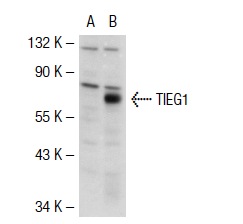
Western blot analysis of TIEG1 expression in non-transfected: (A) and mouse TIEG1 transfected: (B) 293T whole cell lysates.| Product Name | TIEG1 Antibody (H-190) |
|---|---|
| Antibody Type | Primary Antibodies |
| Antigen Alias | epitope corresponding to amino acids 191-380 mapping within an internal region of TIEG1 of human origin |
| Modification Notes | Originally isolated from osteoblastic cells, the TGF∫-inducible early gene-1 (TIEG1) is a Krupel-like zinc finger transcription factor-encoding gene which regulates cellular growth and differentiation. TIEG1 is regulated as an early response gene by TGF∫1. It is expressed in both acinar and ductular epithelial cells from exocrine pancreas and may serve as an early response gene in pancreatic cell lines. Further, overexpression of TIEG1 in TGF∫-sensitive epithelial cells induces apoptosis. TIEG1 and EGRa are expressed from alternate promoters of the same gene. Both are highly expressed in human fetal osteoblast cells. TIEG1 is additionally expressed at high levels in PBLs, spleen and colon, and at lower levels in thymus, small intestine, ovary, prostate and skeletal muscle. The nuclear TIEG2 protein, which shares significant homology with TIEG1, was originally isolated from globin-expressing human fetal erythroid cells. TIEG2 is also expressed in fetal liver. Overexpression of TIEG2 in cultured epithelial cells inhibits cellular proliferation. TIEG2 expression is upregulated by TGF∫1 and serum deprivation. |
| Clonality | Polyclonal |
|---|---|
| Isotype | IgG |
| Host Species | Rabbit |
| Tested Applications | WBIPIFELISA |
| recommended for detection of TIEG1 of mouse, rat and human origin by WB, IP, IF and ELISA also reactive with additional species, including equine, canine, bovine and porcine: |
|
| Species Reactivity | HumanMouseRat |
| Concentration | 1mg/ml |
| Purification | Affinity purified |
| Alternative Names | epitope corresponding to amino acids 191-380 mapping within an internal region of TIEG1 of human origin |
|---|---|
| Tissue Specificity | epitope corresponding to amino acids 191-380 mapping within an internal region of TIEG1 of human origin |
| Entrez Gene | 7071 |
|---|
Application
Western blot analysis of TIEG1 expression in non-transfected: (A) and mouse TIEG1 transfected: (B) 293T whole cell lysates.| Application Notes | recommended for detection of TIEG1 of mouse, rat and human origin by WB, IP, IF and ELISA also reactive with additional species, including equine, canine, bovine and porcine: |
|---|
| Form | Liquid |
|---|---|
| Storage Instructions | For short-term storage, store at 4° C. For long-term storage, aliquot and store at -20ºC or below. Avoid multiple freeze-thaw cycles. |
| Storage Buffer | phosphate buffered saline , pH 7.4, 150mM NaCl, 0.02% sodium azide and 50% glycerol. |


