Application
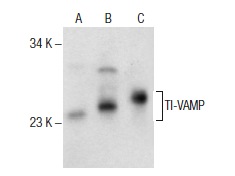
Western blot analysis of TI-VAMP expression in HeLa (A) and PC-12 (B) whole cell lysates and rat brain tissue extract (C).| Product Name | TI-VAMP Antibody (H-55) |
|---|---|
| Antibody Type | Primary Antibodies |
| Antigen Alias | epitope corresponding to amino acids 91-145 mapping within an internal region of TI-VAMP of human origin |
| Modification Notes | Syntaxins were originally thought to be docking proteins, but have more recently been categorized as anchoring proteins that anchor themselves to the cytoplasmic surfaces of cellular membranes. Syntaxins have been shown to bind to various proteins involved in exocytosis, including VAMPs (vesicle-associated membrane proteins, also designated synaptobrevins), NSF (N-ethylmaleimide-sensitive factor), SNAP 25 (synaptosomal-associated protein 25), SNAPs (soluble NSF attachment proteins) and synaptotagmin. Exocytotic vesicles are inserted into the plasma membrane by exocytosis and retrieved by endocytosis. VAMPs are vesicular factors that are important components of the machinery controlling docking and/or fusion of secretory vesicles with their target membrane. Tetanus insensitive VAMP (TI-VAMP) is a type IV membrane protein that is widely expressed. TI-VAMP and cellubrevin form a SNARE complex at the apical plasma membrane. TI-VAMP is insensitive to clostridial neurotoxins. |
| Clonality | Polyclonal |
|---|---|
| Isotype | IgG |
| Host Species | Rabbit |
| Tested Applications | WBIPIFELISA |
| recommended for detection of TI-VAMP of mouse, rat and human origin by WB, IP, IF and ELISA also reactive with additional species, including equine, canine, bovine, porcine and avian: |
|
| Species Reactivity | HumanMouseRat |
| Concentration | 1mg/ml |
| Purification | Affinity purified |
| Alternative Names | epitope corresponding to amino acids 91-145 mapping within an internal region of TI-VAMP of human origin |
|---|---|
| Tissue Specificity | epitope corresponding to amino acids 91-145 mapping within an internal region of TI-VAMP of human origin |
| Entrez Gene | 6845 |
|---|
Application
Western blot analysis of TI-VAMP expression in HeLa (A) and PC-12 (B) whole cell lysates and rat brain tissue extract (C).| Application Notes | recommended for detection of TI-VAMP of mouse, rat and human origin by WB, IP, IF and ELISA also reactive with additional species, including equine, canine, bovine, porcine and avian: |
|---|
| Form | Liquid |
|---|---|
| Storage Instructions | For short-term storage, store at 4° C. For long-term storage, aliquot and store at -20ºC or below. Avoid multiple freeze-thaw cycles. |
| Storage Buffer | phosphate buffered saline , pH 7.4, 150mM NaCl, 0.02% sodium azide and 50% glycerol. |


