Application
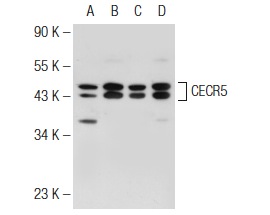
Western blot analysis of CECR5 expression in HeLa (A), Jurkat (B), C2C12 (C) and CCRF-CEM (D) whole cell lysates.| Product Name | CECR5 Antibody (N-14) |
|---|---|
| Antibody Type | Primary Antibodies |
| Antigen Alias | epitope mapping near the N-terminus of CECR5 of human origin |
| Modification Notes | Adenosine deaminase is an enzyme that is present in most tissues and exists predominantly as a monomer, although in some tissues it is associated with adenosine deaminase-binding protein. Adenosine deaminase degrades extracellular adenosine, which is toxic for lymphocytes. A novel family of growth factors that share sequence similarity to adenosine deaminase has been identified. The cat eye syndrome critical region protein (CECR) family includes CECR1, CECR2, CECR3, CECR4, CECR5, CECR6, CECR7, CECR8 and CECR9. The genes encoding CECR proteins are candidates for Cat Eye Syndrome (CES), a developmental disorder associated with the duplication of a 2 Mb region of 22q11.2. CES is characterized by the combination of coloboma of the iris and anal atresia with fistula, downslanting palpebral fissures, preauricular tags and/or pits, frequent occurrence of heart and renal malformations, and normal or near-normal mental development. CECR family members are widely expressed. Specifically, CECR1 has the highest expression in adult heart, lung, lymphoblasts and placenta. CECR2 is also involved in neurulation and chromatin remodeling. Mutations in the CECR2 gene result in neural tube defects. |
| Clonality | Polyclonal |
|---|---|
| Isotype | IgG |
| Host Species | Rabbit |
| Tested Applications | WBIPIFELISA |
| recommended for detection of CECR5 of mouse, rat and human origin by WB, IP, IF and ELISA also reactive with additional species, including equine, canine, bovine and porcine: |
|
| Species Reactivity | HumanMouseRat |
| Concentration | 1mg/ml |
| Purification | Affinity purified |
| Alternative Names | epitope mapping near the N-terminus of CECR5 of human origin |
|---|---|
| Tissue Specificity | epitope mapping near the N-terminus of CECR5 of human origin |
| Entrez Gene | 27440 |
|---|
Application
Western blot analysis of CECR5 expression in HeLa (A), Jurkat (B), C2C12 (C) and CCRF-CEM (D) whole cell lysates.| Application Notes | recommended for detection of CECR5 of mouse, rat and human origin by WB, IP, IF and ELISA also reactive with additional species, including equine, canine, bovine and porcine: |
|---|
| Form | Liquid |
|---|---|
| Storage Instructions | For short-term storage, store at 4° C. For long-term storage, aliquot and store at -20ºC or below. Avoid multiple freeze-thaw cycles. |
| Storage Buffer | phosphate buffered saline , pH 7.4, 150mM NaCl, 0.02% sodium azide and 50% glycerol. |


