Application
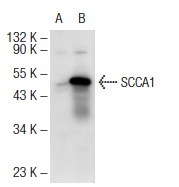
Western blot analysis of SCCA1 expression in non-transfected: (A) and human SCCA1 transfected: (B) 293T whole cell lysates.| Product Name | SCCA1/2 Antibody (H-390) |
|---|---|
| Antibody Type | Primary Antibodies |
| Antigen Alias | raised against amino acids 1-390 of SCCA of human origin |
| Modification Notes | Metastasis of a primary tumor to a distant site is determined through signaling cascades that break down interactions between the cell and extracellular matrix proteins. Among the proteins mediating metastasis are serine prote-ases, such as neutrophil elastase. In 1985, Dr. Jim Travis and Dr. R.W. Carrell designated an emerging family of serine protease inhibitors as the serpin fam-ily, which share homology in both primary amino acid sequence and tertiary structure. Serpins contain a stretch of peptide that mimics a true substrate for a corresponding serine protease. Serine proteases bind to this substrate mimic in a 1:1 stoichiometric fashion and become catalytically inactive. Aberrant ex-pression of serpin family members can contribute to a number of conditions, including emphysema (a-1 antitrypsin deficiency), fatal bleeding (elastase to thrombin specificity) and thrombosis (antithrombin deficiency), and are indicators of cancer stage phenotypes (circulating levels of squamous cell carcinoma antigen, known as SCCA1, increase in advancing stages of some cervical, lung, esophageal and head and neck cancers). Human chromosome position 18q21.3 contains a cluster of serpins, including a tandem duplication of the SCCA gene, plasminogen activator inhibitor type 2, and maspin. SCCA is transcribed by two nearly identical genes (SCCA1 and SCCA2), and is mainly produced as SCCA1. The human SCCA1 gene encodes a 390 amino acid protein that was originally isolated from a metastatic cervical squamous cell carcinoma. |
| Clonality | Polyclonal |
|---|---|
| Isotype | IgG |
| Host Species | Rabbit |
| Tested Applications | WBIPIFELISA |
| recommended for detection of SCCA1 and 2 of human origin by WB, IP, IF and ELISA: |
|
| Species Reactivity | HumanMouseRat |
| Concentration | 1mg/ml |
| Purification | Affinity purified |
| Alternative Names | raised against amino acids 1-390 of SCCA of human origin |
|---|---|
| Tissue Specificity | raised against amino acids 1-390 of SCCA of human origin |
| Entrez Gene | 6317 |
|---|
Application
Western blot analysis of SCCA1 expression in non-transfected: (A) and human SCCA1 transfected: (B) 293T whole cell lysates.| Application Notes | recommended for detection of SCCA1 and 2 of human origin by WB, IP, IF and ELISA: |
|---|
| Form | Liquid |
|---|---|
| Storage Instructions | For short-term storage, store at 4° C. For long-term storage, aliquot and store at -20ºC or below. Avoid multiple freeze-thaw cycles. |
| Storage Buffer | phosphate buffered saline , pH 7.4, 150mM NaCl, 0.02% sodium azide and 50% glycerol. |


