Application
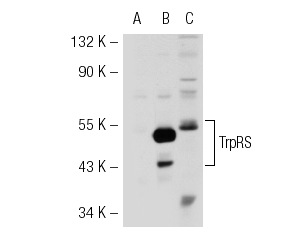
Western blot analysis of TrpRS expression in non-transfected 293T: (A) and mouse TrpRS transfected 293T: (B) and HeLa (C) whole cell lysates.| Product Name | TrpRS Antibody (H-300) |
|---|---|
| Antibody Type | Primary Antibodies |
| Antigen Alias | epitope corresponding to amino acids 171-470 mapping at the C-terminus of TrpRS of human origin |
| Modification Notes | Tryptophanyl-tRNA synthetases are essential enzymes that catalyze the aminoacylation of tRNA(trp) with tryptophan, an essential function of the protein synthesis machinery of the cell. Two forms of tryptophanyl-tRNA synthetase exist: a cytoplasmic form, named TrpRS (also known as WARS), and a mitochondrial form, named WARS2. In normal cells, human TrpRS exists as a full length form and as a truncated form designated mini TrpRS, which is produced by alternative splicing. Expression of mini TrpRs is highly stimulated in human cells by the addition of IFN-gamma. Although both human full-length TrpRS and mini TrpRS are enzymatically active in aminoacylation, they differ in angiostatic activity. The gene encoding human TrpRS maps to chromosome 14q32.31 and the gene encoding human WARS2 maps to chromosome 1p13.3-p13.1. The first 18 amino acids of WARS2 constitute the mitochondrial localization signal sequence. |
| Clonality | Polyclonal |
|---|---|
| Isotype | IgG |
| Host Species | Rabbit |
| Tested Applications | WBIPIFELISA |
| recommended for detection of TrpRS of mouse, rat and human origin by WB, IP, IF and ELISA also reactive with additional species, including equine, canine, bovine and porcine: |
|
| Species Reactivity | HumanMouseRat |
| Concentration | 1mg/ml |
| Purification | Affinity purified |
| Alternative Names | epitope corresponding to amino acids 171-470 mapping at the C-terminus of TrpRS of human origin |
|---|---|
| Tissue Specificity | epitope corresponding to amino acids 171-470 mapping at the C-terminus of TrpRS of human origin |
| Entrez Gene | 7453 |
|---|
Application
Western blot analysis of TrpRS expression in non-transfected 293T: (A) and mouse TrpRS transfected 293T: (B) and HeLa (C) whole cell lysates.| Application Notes | recommended for detection of TrpRS of mouse, rat and human origin by WB, IP, IF and ELISA also reactive with additional species, including equine, canine, bovine and porcine: |
|---|
| Form | Liquid |
|---|---|
| Storage Instructions | For short-term storage, store at 4° C. For long-term storage, aliquot and store at -20ºC or below. Avoid multiple freeze-thaw cycles. |
| Storage Buffer | phosphate buffered saline , pH 7.4, 150mM NaCl, 0.02% sodium azide and 50% glycerol. |


