Application
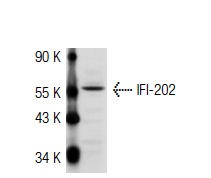
Western blot analysis of IFI-202 expression in RAW 264.7 whole cell lysate.| Product Name | IFI-202 Antibody (M-70) |
|---|---|
| Antibody Type | Primary Antibodies |
| Antigen Alias | epitope corresponding to amino acids 316-385 mapping near the C-terminus of IFI-202 of mouse origin |
| Modification Notes | Interferon-inducible proteins include IFI-202, IFI-203, IFI-204 and D3, which are encoded by six or more structurally related and IFN-inducible mouse genes mapping at the q21-q23 region of chromosome 1 (1–3). The proteins encoded by these genes have homologous 200 amino acid segments (1). IFI-202 is a primarily nuclear phosphoprotein which inhibits cell growth, in part by modulating transcriptional activity of NFkB, E2F, AP-1 and p53 (4–6). Two related human proteins, MNDA (myeloid cell nuclear differentiation antigen) and IFI-16, have also been described (7,8). Expression of MNDA has been observed specifically in cells of the granulocyte-macrophage lineage (8). IFI-16 is constitutively expressed in various T and B cell lines and can be induced by IFN-g in HL60 cells (7). At least four of the Gene 200 cluster of IFN-inducible proteins, IFI-202, IFI-204, MNDA and IFI-16, are localized in the nucleus (6–8). |
| Clonality | Polyclonal |
|---|---|
| Isotype | IgG |
| Host Species | Rabbit |
| Tested Applications | WBIPIFELISA |
| recommended for detection of IFI-202a and IFI-202b of mouse origin by WB, IP, IF and ELISA: |
|
| Species Reactivity | HumanMouseRat |
| Concentration | 1mg/ml |
| Purification | Affinity purified |
| Alternative Names | epitope corresponding to amino acids 316-385 mapping near the C-terminus of IFI-202 of mouse origin |
|---|---|
| Tissue Specificity | epitope corresponding to amino acids 316-385 mapping near the C-terminus of IFI-202 of mouse origin |
| Entrez Gene | 26388 |
|---|
Application
Western blot analysis of IFI-202 expression in RAW 264.7 whole cell lysate.| Application Notes | recommended for detection of IFI-202a and IFI-202b of mouse origin by WB, IP, IF and ELISA: |
|---|
| Form | Liquid |
|---|---|
| Storage Instructions | For short-term storage, store at 4° C. For long-term storage, aliquot and store at -20ºC or below. Avoid multiple freeze-thaw cycles. |
| Storage Buffer | phosphate buffered saline , pH 7.4, 150mM NaCl, 0.02% sodium azide and 50% glycerol. |


