Application
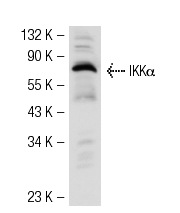
Western blot analysis of IKKα expression in HeLa whole cell lysate.Application
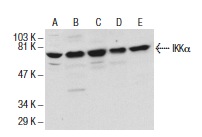
Western blot analysis of IKKα expression in A-673 (A), BJAB (B), Jurkat (C), WEHI-231 (D) and PC-12 (E) whole cell lysates.| Product Name | IKKα Antibody (M-280) AC |
|---|---|
| Antibody Type | Primary Antibodies |
| Antigen Alias | epitope corresponding to amino acids 465-745 mapping at the C-terminus of IKKα of mouse origin |
| Modification Notes | The transcription factor NFkB is retained in the cytoplasm in an inactive form by the inhibitory protein IkB. Activation of NFkB requires that IkB be phosphorylated on specific serine residues, which results in targeted degradation of IkB. IkB kinase a (IKKa), previously designated CHUK, interacts with IkB-a and specifically phosphorylates IkB-a on Ser 32 and 36, the sites that trigger its degradation. IKKa appears to be critical for NFkB activation in response to proinflammatory cytokines. Phosphorylation of IkB by IKKa is stimulated by the NFkB inducing kinase (NIK), which itself is a central regulator for NFkB activation in response to TNF and IL-1. The functional IKK complex contains three subunits, IKKa, IKKb and IKKg (also designated NEMO), and each appear to make essential contributions to IkB phosphorylation. |
| Clonality | Polyclonal |
|---|---|
| Isotype | IgG |
| Host Species | Rabbit |
| Tested Applications | WBIPIFELISA |
| recommended for detection of IKKα of mouse, rat and human origin by WB, IP, IF and ELISA also reactive with additional species, including equine, canine, bovine and porcine: |
|
| Species Reactivity | HumanMouseRat |
| Concentration | 1mg/ml |
| Purification | Affinity purified |
| Alternative Names | epitope corresponding to amino acids 465-745 mapping at the C-terminus of IKK&alpha of mouse origin |
|---|---|
| Tissue Specificity | epitope corresponding to amino acids 465-745 mapping at the C-terminus of IKKα of mouse origin |
| Entrez Gene | 1147 |
|---|
Application
Western blot analysis of IKKα expression in HeLa whole cell lysate.
Application
Western blot analysis of IKKα expression in A-673 (A), BJAB (B), Jurkat (C), WEHI-231 (D) and PC-12 (E) whole cell lysates.| Application Notes | recommended for detection of IKKα of mouse, rat and human origin by WB, IP, IF and ELISA also reactive with additional species, including equine, canine, bovine and porcine: |
|---|
| Form | Liquid |
|---|---|
| Storage Instructions | For short-term storage, store at 4° C. For long-term storage, aliquot and store at -20ºC or below. Avoid multiple freeze-thaw cycles. |
| Storage Buffer | phosphate buffered saline , pH 7.4, 150mM NaCl, 0.02% sodium azide and 50% glycerol. |


