Application
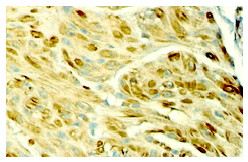
Immunoperoxidase staining of formalin-fixed, paraffin-embedded human bladder tumor showing nuclear localization.| Product Name | Pax-3/7 Antibody (H-208) |
|---|---|
| Antibody Type | Primary Antibodies |
| Antigen Alias | epitope corresponding to amino acids 272-479 mapping at the C-terminus of Pax-3 of human origin |
| Modification Notes | Pax genes contain paired domains that share strong homology to genes in Drosophila which are involved in programming early development. The product of the Pax-3 gene is a DNA-binding protein expressed during early neurogenesis. Pax-3 is a protein containing both a paired domain and a paired-type homeodomain. During early neurogenesis, Pax-3 expression is limited to mitotic cells in the ventricular zone of the developing spinal cord and to distinct regions in the hindbrain, midbrain and diencephalon. In 10-12 day embryos, expression of Pax-3 is also seen in neural crest cells of the developing spinal ganglia, the craniofacial mesectoderm and in limb mesenchyme. Mutations in the MITF and Pax-3 genes, encoding transcriptions factors, are responsible for Waardenburg syndrome II (WS2) and WS1/WS3, respectively. Pax-7 is a gene specifically expressed in cultured satellite cell-derived myoblasts. In situ hybridization revealed that Pax-7 is also expressed in satellite cells residing in adult muscle. The gene which encodes Pax-7 maps to human chromosome 1p36.2-p36.12. |
| Clonality | Polyclonal |
|---|---|
| Isotype | IgG |
| Host Species | Rabbit |
| Tested Applications | WBIPIFIHCELISAGSChIP |
| recommended for detection of Pax3 and Pax7 of mouse, rat and human origin by WB, IP, IF, IHC(P) and ELISA also reactive with additional species, including equine: |
|
| Species Reactivity | HumanMouseRat |
| Concentration | 1mg/ml |
| Purification | Affinity purified |
| Alternative Names | epitope corresponding to amino acids 272-479 mapping at the C-terminus of Pax-3 of human origin |
|---|---|
| Tissue Specificity | epitope corresponding to amino acids 272-479 mapping at the C-terminus of Pax-3 of human origin |
| Entrez Gene | 5077 |
|---|
Application
Immunoperoxidase staining of formalin-fixed, paraffin-embedded human bladder tumor showing nuclear localization.| Application Notes | recommended for detection of Pax3 and Pax7 of mouse, rat and human origin by WB, IP, IF, IHC(P) and ELISA also reactive with additional species, including equine: |
|---|
| Form | Liquid |
|---|---|
| Storage Instructions | For short-term storage, store at 4° C. For long-term storage, aliquot and store at -20ºC or below. Avoid multiple freeze-thaw cycles. |
| Storage Buffer | phosphate buffered saline , pH 7.4, 150mM NaCl, 0.02% sodium azide and 50% glycerol. |


