Application
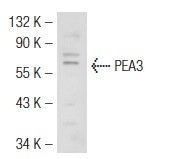
Western blot analysis of PEA3 expression in K-562 whole cell lysate.| Product Name | PEA3 Antibody (H-120) |
|---|---|
| Antibody Type | Primary Antibodies |
| Antigen Alias | epitope corresponding to amino acids 171-290 mapping near the N-terminus of PEA3 of human origin |
| Modification Notes | Several members of the Ets gene family are known to encode sequence-specific DNA binding proteins. These include mouse PU.1, mouse and human Ets-1, Drosophila E74, chicken and human Ets-2 and rat GABP-a. Each of these proteins recognizes similar motifs in DNA that share a centrally located 5'-GGAA-3' element. For instance, PEA3 binds the motif 5'-AGGAAG-3' (the PEA-3 motif), but does not bind to the sequence 5'-AGGAAC-3', recognized by PU.1, although PU.1 binds equally well to both sequences. It appears that all of the Ets proteins recognize the same central core sequence but that each protein interacts with unique sequences that flank this core. PEA3 is expressed at readily detectable levels in cells of epithelial and fibroblastic origin but is not expressed in hematopoietic cells. This is in contrast to other members of the Ets gene family, such as Ets-1, Ets-2 and Fli-1, each of which is expressed primarily in cells of hematopoietic origin. |
| Clonality | Polyclonal |
|---|---|
| Isotype | IgG |
| Host Species | Rabbit |
| Tested Applications | WBIPIFELISAGSChIP |
| recommended for detection of PEA3 of mouse, rat and human origin by WB, IP, IF and ELISA also reactive with additional species, including equine, canine and porcine: |
|
| Species Reactivity | HumanMouseRat |
| Concentration | 1mg/ml |
| Purification | Affinity purified |
| Alternative Names | epitope corresponding to amino acids 171-290 mapping near the N-terminus of PEA3 of human origin |
|---|---|
| Tissue Specificity | epitope corresponding to amino acids 171-290 mapping near the N-terminus of PEA3 of human origin |
| Entrez Gene | 2118 |
|---|
Application
Western blot analysis of PEA3 expression in K-562 whole cell lysate.| Application Notes | recommended for detection of PEA3 of mouse, rat and human origin by WB, IP, IF and ELISA also reactive with additional species, including equine, canine and porcine: |
|---|
| Form | Liquid |
|---|---|
| Storage Instructions | For short-term storage, store at 4° C. For long-term storage, aliquot and store at -20ºC or below. Avoid multiple freeze-thaw cycles. |
| Storage Buffer | phosphate buffered saline , pH 7.4, 150mM NaCl, 0.02% sodium azide and 50% glycerol. |


