Application
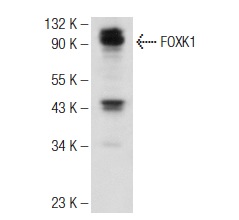
Western blot analysis of FOXK1 expression in HeLa nuclear extract.Application
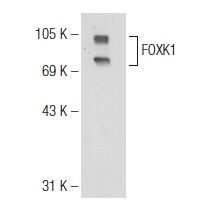
Western blot analysis of FOXK1 expression in NIH/3T3 whole cell lysate.| Product Name | FOXK1 Antibody (H-140) |
|---|---|
| Antibody Type | Primary Antibodies |
| Antigen Alias | epitope corresponding to amino acids 472-611 mapping near the C-terminus of FOXK1 of human origin |
| Modification Notes | The FOX family of transcription factors share a common DIUA binding domain termed a winged-helix or forkhead domain. Many FOX proteins play important roles in development, metabolism, cancer and aging. In skeletal muscles, undifferentiated myogenic stem cells (satellite cells) can mobilize to regenerate myofibers in response to injury. FOXK1 is expressed in these cells and regulates cell cycle progression through an interaction with its downstream target the cyclin-dependent kinase inhibitor p21 (CIP). Loss of FOXK1 in mice results in growth retardation and a severe impairment in skeletal muscle regeneration following injury. FOXK1 also shows expression in immature tissues of brain, eye, heart, lung and thymus. It also is predominantly expressed in many malignant tissues, such as tumors of the brain, colon and lymph node. |
| Clonality | Polyclonal |
|---|---|
| Isotype | IgG |
| Host Species | Rabbit |
| Tested Applications | WBIPIFELISA |
| recommended for detection of Forkhead box protein K1 of mouse, rat and human origin by WB, IP, IF and ELISA also reactive with additional species, including equine, canine and porcine: |
|
| Species Reactivity | HumanMouseRat |
| Concentration | 1mg/ml |
| Purification | Affinity purified |
| Alternative Names | epitope corresponding to amino acids 472-611 mapping near the C-terminus of FOXK1 of human origin |
|---|---|
| Tissue Specificity | epitope corresponding to amino acids 472-611 mapping near the C-terminus of FOXK1 of human origin |
Application
Western blot analysis of FOXK1 expression in HeLa nuclear extract.
Application
Western blot analysis of FOXK1 expression in NIH/3T3 whole cell lysate.| Application Notes | recommended for detection of Forkhead box protein K1 of mouse, rat and human origin by WB, IP, IF and ELISA also reactive with additional species, including equine, canine and porcine: |
|---|
| Form | Liquid |
|---|---|
| Storage Instructions | For short-term storage, store at 4° C. For long-term storage, aliquot and store at -20ºC or below. Avoid multiple freeze-thaw cycles. |
| Storage Buffer | phosphate buffered saline , pH 7.4, 150mM NaCl, 0.02% sodium azide and 50% glycerol. |


