Application
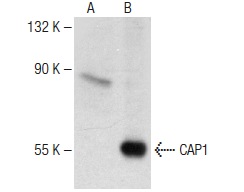
Western blot analysis of CAP1 expression in non-transfected: (A) and mouse CAP1 transfected: (B) 293T whole cell lysates.Application
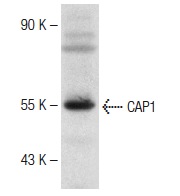
Western blot analysis of CAP1 expression in HL-60 whole cell lysate.| Product Name | CAP1 Antibody (H-61) |
|---|---|
| Antibody Type | Primary Antibodies |
| Antigen Alias | epitope corresponding to amino acids 14-74 mapping near the N-terminus of CAP1 of human origin |
| Modification Notes | Cyclase-associated proteins (CAPs) are a family of evolutionary conserved proteins that participate in signal transduction and function to regulate events associated with the actin cytoskeleton. CAP1 and CAP2 (adenylate cyclase-associated protein 1 and 2, respectively) are two members of the CAP family, both of which localize to the cell membrane and contain one C-CAP/cofactor C-like domain. CAP1 is involved in the regulation of actin filaments and is thought to mediate processes such as establishment of cell polarity and mRNA localization, while CAP2 has a bifunctional regulatory role and can interact directly with actin. Although CAP1 is expressed throughout the body, CAP2 is predominately expressed in skin, brain, heart and skeletal muscle. Overexpression of CAP2 is associated with hepatocellular carcinoma, suggesting a possible role for CAP2 in carcinogenesis. |
| Clonality | Polyclonal |
|---|---|
| Isotype | IgG |
| Host Species | Rabbit |
| Tested Applications | WBIPIFELISA |
| recommended for detection of CAP1 of mouse, rat and human origin by WB, IP, IF and ELISA also reactive with additional species, including canine, bovine and porcine: |
|
| Species Reactivity | HumanMouseRat |
| Concentration | 1mg/ml |
| Purification | Affinity purified |
| Alternative Names | epitope corresponding to amino acids 14-74 mapping near the N-terminus of CAP1 of human origin |
|---|---|
| Tissue Specificity | epitope corresponding to amino acids 14-74 mapping near the N-terminus of CAP1 of human origin |
Application
Western blot analysis of CAP1 expression in non-transfected: (A) and mouse CAP1 transfected: (B) 293T whole cell lysates.
Application
Western blot analysis of CAP1 expression in HL-60 whole cell lysate.| Application Notes | recommended for detection of CAP1 of mouse, rat and human origin by WB, IP, IF and ELISA also reactive with additional species, including canine, bovine and porcine: |
|---|
| Form | Liquid |
|---|---|
| Storage Instructions | For short-term storage, store at 4° C. For long-term storage, aliquot and store at -20ºC or below. Avoid multiple freeze-thaw cycles. |
| Storage Buffer | phosphate buffered saline , pH 7.4, 150mM NaCl, 0.02% sodium azide and 50% glycerol. |


