Application
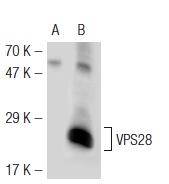
Western blot analysis of VPS28 expression in non-transfected: (A) and mouse VPS28 transfected: (B) 293T whole cell lysates.| Product Name | VPS28 Antibody (FL-221) |
|---|---|
| Antibody Type | Primary Antibodies |
| Antigen Alias | epitope corresponding to amino acids 1-221 representing full length VPS28 of human origin |
| Modification Notes | Vacuolar protein sorting protein 28 (VPS28) is required for normal endocytic and biosynthetic trafficking to the vacuole. VPS28 mutants accumulate vacuolar endocytic and late Golgi markers in an abberant endosome-like class E compartment. Class E compartments contain endocytosed markers, as well as precursors of vacuolar hydrolases and markers normally associated with the trans Golgi. VPS28 as well as other class E VPS proteins may facilitate the formation of transport intermediates required for efficient transport out of the prevacuolar endosome. Class E proteins appear to be important for sorting material bound for the vacuole away from proteins that cycle through the endocytic system. VPS28 of Saccharomyces cerevisiae and its human ortholog localize to the cytoplasm and can be found as subunits of a complex named ESCRT-1, endosomal sorting complex required for transport 1. |
| Clonality | Polyclonal |
|---|---|
| Isotype | IgG |
| Host Species | Rabbit |
| Tested Applications | WBIPIFELISA |
| recommended for detection of VPS28 of mouse, rat and human origin by WB, IP, IF and ELISA also reactive with additional species, including equine, canine, bovine and porcine: |
|
| Species Reactivity | HumanMouseRat |
| Concentration | 1mg/ml |
| Purification | Affinity purified |
| Alternative Names | epitope corresponding to amino acids 1-221 representing full length VPS28 of human origin |
|---|---|
| Tissue Specificity | epitope corresponding to amino acids 1-221 representing full length VPS28 of human origin |
| Entrez Gene | 51160 |
|---|
Application
Western blot analysis of VPS28 expression in non-transfected: (A) and mouse VPS28 transfected: (B) 293T whole cell lysates.| Application Notes | recommended for detection of VPS28 of mouse, rat and human origin by WB, IP, IF and ELISA also reactive with additional species, including equine, canine, bovine and porcine: |
|---|
| Form | Liquid |
|---|---|
| Storage Instructions | For short-term storage, store at 4° C. For long-term storage, aliquot and store at -20ºC or below. Avoid multiple freeze-thaw cycles. |
| Storage Buffer | phosphate buffered saline , pH 7.4, 150mM NaCl, 0.02% sodium azide and 50% glycerol. |


