Application
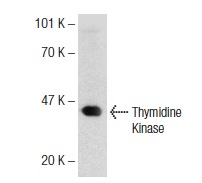
Western blot analysis of Thymidine Kinase expression in K-562 whole cell lysate.| Product Name | Thymidine Kinase Antibody (FL-234) |
|---|---|
| Antibody Type | Primary Antibodies |
| Antigen Alias | epitope corresponding to amino acids 1-234 representing full length Thymidine Kinase of human origin |
| Modification Notes | Thymidine Kinase (TK1) is a highly conserved phosphotransferase that is present in most living cells. Thymidine Kinase catalyzes the phosphorylation reaction: deoxythymidine + ATP = deoxythymidine 5'-phosphate + ADP; it is thus involved in the reaction chain to introduce deoxythymidine into the DNA. Thymidine kinase is required for the action of many antiviral drugs, such as azidothymidine (AZT), and is is also used to select hybridoma cell lines in the production of monoclonal antibodies. Thymidine Kinase has many clinical applications as it is only present in anticipation of cell division. Because of this, Thymidine Kinase can be used as a proliferation marker in the diagnosis, treatment, and follow-up of malignant diseases, especially hematological malignancies. Thymidine Kinase may be observed as a monomer, dimer, trimer or tetramer. |
| Clonality | Polyclonal |
|---|---|
| Isotype | IgG |
| Host Species | Rabbit |
| Tested Applications | WBIPIFELISA |
| recommended for detection of Thymidine Kinase of mouse, rat and human origin by WB, IP, IF and ELISA also reactive with additional species, including canine and bovine: |
|
| Species Reactivity | HumanMouseRat |
| Concentration | 1mg/ml |
| Purification | Affinity purified |
| Alternative Names | epitope corresponding to amino acids 1-234 representing full length Thymidine Kinase of human origin |
|---|---|
| Tissue Specificity | epitope corresponding to amino acids 1-234 representing full length Thymidine Kinase of human origin |
| Entrez Gene | 7083 |
|---|
Application
Western blot analysis of Thymidine Kinase expression in K-562 whole cell lysate.| Application Notes | recommended for detection of Thymidine Kinase of mouse, rat and human origin by WB, IP, IF and ELISA also reactive with additional species, including canine and bovine: |
|---|
| Form | Liquid |
|---|---|
| Storage Instructions | For short-term storage, store at 4° C. For long-term storage, aliquot and store at -20ºC or below. Avoid multiple freeze-thaw cycles. |
| Storage Buffer | phosphate buffered saline , pH 7.4, 150mM NaCl, 0.02% sodium azide and 50% glycerol. |


