Application
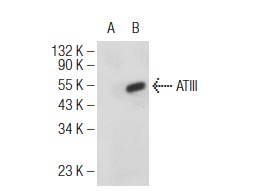
Western blot analysis of ATIII expression in non-transfected: (A) and mouse ATIII transfected: (B) 293T whole cell lysates.| Product Name | ATIII Antibody (H-70) |
|---|---|
| Antibody Type | Primary Antibodies |
| Antigen Alias | epitope corresponding to amino acids 331-400 mapping near the C-terminus of ATIII of human origin |
| Modification Notes | The serine proteinase inhibitors (serpins) compose a superfamily of proteins with a diverse set of functions, including the control of blood coagulation, complement activation, programmed cell death and development. Serpins are secreted glycoproteins that contain a stretch of peptide that mimics a true substrate for a corresponding serine protease. Antithrombin III (ATIII), an extracellular plasma protein, is a crucial serine protease inhibitor that regulates the coagulation cascade in blood. The inhibitory activity of ATIII is amplified in the presence of heparin. ATIII inhibits Thrombin and Factors IXa, Xa and XIa. Defects in the gene SERPINC1, which encodes for ATIII, can cause ATIII deficiency, an autosomal dominant disease which is a risk factor for hereditary thrombophilia. |
| Clonality | Polyclonal |
|---|---|
| Isotype | IgG |
| Host Species | Rabbit |
| Tested Applications | WBIPIFELISA |
| recommended for detection of Antithrombin III (ATIII) of mouse, rat and human origin by WB, IP, IF and ELISA also reactive with additional species, including equine and bovine: |
|
| Species Reactivity | HumanMouseRat |
| Concentration | 1mg/ml |
| Purification | Affinity purified |
| Alternative Names | epitope corresponding to amino acids 331-400 mapping near the C-terminus of ATIII of human origin |
|---|---|
| Tissue Specificity | epitope corresponding to amino acids 331-400 mapping near the C-terminus of ATIII of human origin |
| Entrez Gene | 462 |
|---|
Application
Western blot analysis of ATIII expression in non-transfected: (A) and mouse ATIII transfected: (B) 293T whole cell lysates.| Application Notes | recommended for detection of Antithrombin III (ATIII) of mouse, rat and human origin by WB, IP, IF and ELISA also reactive with additional species, including equine and bovine: |
|---|
| Form | Liquid |
|---|---|
| Storage Instructions | For short-term storage, store at 4° C. For long-term storage, aliquot and store at -20ºC or below. Avoid multiple freeze-thaw cycles. |
| Storage Buffer | phosphate buffered saline , pH 7.4, 150mM NaCl, 0.02% sodium azide and 50% glycerol. |


