Application
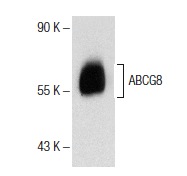
Western blot analysis of ABCG8 expression in human fetal liver tissue extract.Application
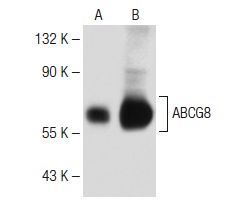
Western blot analysis of ABCG8 expression in c4 whole cell lysate (A) and mouse liver tissue extract (B).| Product Name | ABCG8 Antibody (H-300) |
|---|---|
| Antibody Type | Primary Antibodies |
| Antigen Alias | epitope corresponding to amino acids 374-673 mapping at the C-terminus of ABCG8 of human origin |
| Modification Notes | The ABCG (White) subfamily of ABC transporters, which includes ABCG1, ABCG5 and ABCG8, are critically involved in the regulation of lipid-trafficking mechanisms in macrophages, hepatocyes and intestinal mucosa cells. ABCG8 (also designated Sterolin-2) is expressed in the liver, small intestine and colon. ABCG8 normally cooperates with ABCG5 to limit intestinal absorption and to promote biliary excretion of sterols, whereas mutated forms of ABCG8 and ABCG5 cause sterol accumulation and atherosclerosis. ABCG8 and ABCG5 genes are also distinct targets of the LXRa and LXRb oxysterol receptors, which serve as sterol sensors to coordinately regulate sterol catabolism, storage, efflux and elimination. Mutations in either ABCG8 or ABCG5 lead to sitosterolemia, a rare autosomal recessive disorder characterized by hyper-absorption of all sterols, including cholesterol and plant and shellfish sterols. Patients with this disease are hypercholesterolemic and frequently develop xanthomas, accelerated atherosclerosis and premature coronary artery disease. |
| Clonality | Polyclonal |
|---|---|
| Isotype | IgG |
| Host Species | Rabbit |
| Tested Applications | WBIPIFELISA |
| recommended for detection of ABCG8 of mouse, rat and human origin by WB, IP, IF and ELISA: |
|
| Species Reactivity | HumanMouseRat |
| Concentration | 1mg/ml |
| Purification | Affinity purified |
| Alternative Names | epitope corresponding to amino acids 374-673 mapping at the C-terminus of ABCG8 of human origin |
|---|---|
| Tissue Specificity | epitope corresponding to amino acids 374-673 mapping at the C-terminus of ABCG8 of human origin |
| Entrez Gene | 64241 |
|---|
Application
Western blot analysis of ABCG8 expression in human fetal liver tissue extract.
Application
Western blot analysis of ABCG8 expression in c4 whole cell lysate (A) and mouse liver tissue extract (B).| Application Notes | recommended for detection of ABCG8 of mouse, rat and human origin by WB, IP, IF and ELISA: |
|---|
| Form | Liquid |
|---|---|
| Storage Instructions | For short-term storage, store at 4° C. For long-term storage, aliquot and store at -20ºC or below. Avoid multiple freeze-thaw cycles. |
| Storage Buffer | phosphate buffered saline , pH 7.4, 150mM NaCl, 0.02% sodium azide and 50% glycerol. |


