Application
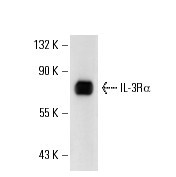
Western blot analysis of mouse recombinant IL-3Rα.| Product Name | IL-3Rα Antibody (M-194) |
|---|---|
| Antibody Type | Primary Antibodies |
| Antigen Alias | epitope corresponding to amino acids 17-210 mapping within an N-terminal extracellular domain of IL-3Rα of mouse origin |
| Modification Notes | Interleukin-3, or IL-3, is a pleiotropic cytokine that is primarily secreted by activated T lymphocytes and stimulates the proliferation and differentiation of hematopoietic cells. IL-3 exerts its biological effects through a receptor which consists of a ligand-specific å subunit (IL-3Rå) and a signal transducing ∫ subunit (IL-3R∫) common to the IL-3/IL-5/GM-CSF receptors. The å subunits are low-affinity ligand-binding proteins while the ∫ subunits do not themselves bind ligand, but are required for high affinity binding by the å subunits. The mouse IL-3 receptor has two distinct ∫ subunits, one that functions only in IL-3-mediated cell signaling and a second that is shared with IL-5 and GM-CSF. The murine ∫ subunits are 91% homologous at the amino acid level but only 56% homologous to the human ∫ subunit. The carboxy-terminus of the ∫ subunit has been shown to be necessary for activation of the MAP kinase signaling pathway. Although the IL-3 receptor has no intrinsic kinase activity, stimulation with IL-3 leads to tyrosine phosphorylation of the JAK/Tyk 2 family member, JAK2, which in turn activates and causes nuclear translocation of Stat5a and Stat5b. |
| Clonality | Polyclonal |
|---|---|
| Isotype | IgG |
| Host Species | Rabbit |
| Tested Applications | WBIPIFELISA |
| recommended for detection of IL-3Rα of mouse and rat origin by WB, IP, IF and ELISA: |
|
| Species Reactivity | HumanMouseRat |
| Concentration | 1mg/ml |
| Purification | Affinity purified |
| Alternative Names | epitope corresponding to amino acids 17-210 mapping within an N-terminal extracellular domain of IL-3R&alpha of mouse origin |
|---|---|
| Tissue Specificity | epitope corresponding to amino acids 17-210 mapping within an N-terminal extracellular domain of IL-3Rα of mouse origin |
| Entrez Gene | 16188 |
|---|
Application
Western blot analysis of mouse recombinant IL-3Rα.| Application Notes | recommended for detection of IL-3Rα of mouse and rat origin by WB, IP, IF and ELISA: |
|---|
| Form | Liquid |
|---|---|
| Storage Instructions | For short-term storage, store at 4° C. For long-term storage, aliquot and store at -20ºC or below. Avoid multiple freeze-thaw cycles. |
| Storage Buffer | phosphate buffered saline , pH 7.4, 150mM NaCl, 0.02% sodium azide and 50% glycerol. |


