Application
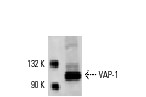
Western blot analysis of VAP-1 expression in human lung tissue extract.| Product Name | VAP-1 Antibody (H-43) |
|---|---|
| Antibody Type | Primary Antibodies |
| Antigen Alias | epitope corresponding to amino acids 721-763 mapping within a C-terminal extracellular domain of VAP-1 of human origin |
| Modification Notes | Lymphocyte binding to vascular endothelium is a prerequisite for the movement of immune cells from the blood into lymphoid tissues and into sites of inflammation. Under inflammatory conditions, cell surface expression of VAP-1 (vascular adhesion protein-1) which is an endothelial sialoglycoprotein, is induced (1-3). VAP-1 is a type II transmembrane protein with a single transmembrane domain and N- and O-glycosylation sites in the extracellular domain (3). In vivo, VAP-1 exists predominantly as a homodimer (2) and functions both as an enzyme (monoamine oxidase) and an adhesion molecule for lymphocytes (4). With the appropriate glycosylation and in the correct inflammatory setting, expression of VAP-1 on the lumenal endothelial cell surface allows it to mediate lymphocyte adhesion and to function as an adhesion receptor involved in lymphocyte recirculation (3). VAP-1 is also expressed in all types of smooth muscle cells, except in cardiac and skeletal muscle cells. VAP-1 localized on smooth muscle cells does not support binding of lymphocytes, but it deaminates exogenous and endogenous primary amines (2). Soluble VAP-1 is found in circulation and its level is increased in patients who have inflammatory liver diseases (5). |
| Clonality | Polyclonal |
|---|---|
| Isotype | IgG |
| Host Species | Rabbit |
| Tested Applications | WBIPIFELISA |
| recommended for detection of VAP-1 of mouse, rat and human origin by WB, IP, IF and ELISA also reactive with additional species, including canine and bovine: |
|
| Species Reactivity | HumanMouseRat |
| Concentration | 1mg/ml |
| Purification | Affinity purified |
| Alternative Names | epitope corresponding to amino acids 721-763 mapping within a C-terminal extracellular domain of VAP-1 of human origin |
|---|---|
| Tissue Specificity | epitope corresponding to amino acids 721-763 mapping within a C-terminal extracellular domain of VAP-1 of human origin |
| Entrez Gene | 8639 |
|---|
Application
Western blot analysis of VAP-1 expression in human lung tissue extract.| Application Notes | recommended for detection of VAP-1 of mouse, rat and human origin by WB, IP, IF and ELISA also reactive with additional species, including canine and bovine: |
|---|
| Form | Liquid |
|---|---|
| Storage Instructions | For short-term storage, store at 4° C. For long-term storage, aliquot and store at -20ºC or below. Avoid multiple freeze-thaw cycles. |
| Storage Buffer | phosphate buffered saline , pH 7.4, 150mM NaCl, 0.02% sodium azide and 50% glycerol. |


