Application
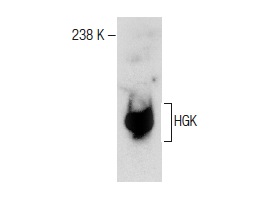
Western blot analysis of HGK expression in rat brain tissue extract.| Product Name | HGK Antibody (M-190) |
|---|---|
| Antibody Type | Primary Antibodies |
| Antigen Alias | epitope corresponding to amino acids 511-700 of HGK of mouse origin |
| Modification Notes | HGK (HPK/GC kinase-like kinase), also known as mitogen-activated protein kinase kinase kinase kinase 4, MAPK/ERK kinase kinase kinase 4, MEKKK 4 or NCK-interacting kinase (NIK), is a member of the serine/threonine kinase subfamily, Ste20. This subfamily is comprised of several mammalian kinases which exhibit sequence similarity to the Saccharomyces cerevisiae serine/threonine kinase, Ste20. Members of this subfamily include KHS, GLK, YSK1, HPK1, Krs-1, Krs-2, GC kinase and HGK. HGK, like many of the Ste20-like kinases, has been shown to activate the SAPK/JNK stress response pathway. HGK interacts with MEK kinase-1 and is thought to act upstream of MEK kinase-1 in the SAPK/JNK signaling pathway. Both the kinase domain and the C-terminal regulatory domain of HGK are required for full activation. |
| Clonality | Polyclonal |
|---|---|
| Isotype | IgG |
| Host Species | Rabbit |
| Tested Applications | WBIPIFELISA |
| recommended for detection of HGK of mouse, rat and human origin by WB, IP, IF and ELISA: |
|
| Species Reactivity | HumanMouseRat |
| Concentration | 1mg/ml |
| Purification | Affinity purified |
| Alternative Names | epitope corresponding to amino acids 511-700 of HGK of mouse origin |
|---|---|
| Tissue Specificity | epitope corresponding to amino acids 511-700 of HGK of mouse origin |
| Entrez Gene | 9448 |
|---|
Application
Western blot analysis of HGK expression in rat brain tissue extract.| Application Notes | recommended for detection of HGK of mouse, rat and human origin by WB, IP, IF and ELISA: |
|---|
| Form | Liquid |
|---|---|
| Storage Instructions | For short-term storage, store at 4° C. For long-term storage, aliquot and store at -20ºC or below. Avoid multiple freeze-thaw cycles. |
| Storage Buffer | phosphate buffered saline , pH 7.4, 150mM NaCl, 0.02% sodium azide and 50% glycerol. |


