Application
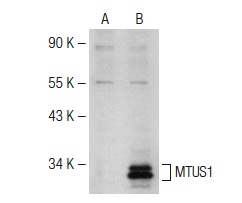
Western blot analysis of MTUS1 expression in non-transfected: (A) and human MTUS1 transfected: (B) 293T whole cell lysates.| Product Name | MTUS1 Antibody (T-12) |
|---|---|
| Antibody Type | Primary Antibodies |
| Antigen Alias | epitope mapping within an internal region of MTUS1 of human origin |
| Modification Notes | MTUS1 (mitochondrial tumor suppressor 1), also known as ATIP (angiotensin-II type 2 receptor (AT2)-interacting protein), MP44, GK1 or MTSG1, is a ubiquitously expressed protein with highest expression in brain tissues. MTUS1 is predominantly hydrophilic and contains a large coiled coil domain and two leucine zippers. It interacts with the C-terminal tail of AT2 and cooperates with this receptor to mediate the inhibition of growth factor-induced ERK 2 activation and cell proliferation. MTUS1 functions as a tumor suppressor and mutations in the gene encoding MTUS1 may result in hepatocellular carcinoma (HCC). Five transcript variants of MTUS1 are produced by alternative splicing events, namely ATIP1, ATIP2, ATIP3a, ATIP3b and ATIP4. ATIP1 exhibits cytosolic localization and ATIP4 localizes to the plasma membrane. ATIP2, ATIP3a and ATIP3b localize to the nucleus and are highly conserved throughout evolution, implying an important function for each in cellular homeostasis. |
| Clonality | Polyclonal |
|---|---|
| Isotype | IgG |
| Host Species | Rabbit |
| Tested Applications | WBIPIFELISA |
| recommended for detection of MTUS1 of m and h origin by WB, IP, IF and ELISA non cross-reactive with MTUS1-3, MTUS1-4, or MTUS1-6 also reactive with additional species, including equine, canine and porcine: |
|
| Species Reactivity | HumanMouseRat |
| Concentration | 1mg/ml |
| Purification | Affinity purified |
| Alternative Names | epitope mapping within an internal region of MTUS1 of human origin |
|---|---|
| Tissue Specificity | epitope mapping within an internal region of MTUS1 of human origin |
| Entrez Gene | 57509 |
|---|
Application
Western blot analysis of MTUS1 expression in non-transfected: (A) and human MTUS1 transfected: (B) 293T whole cell lysates.| Application Notes | recommended for detection of MTUS1 of m and h origin by WB, IP, IF and ELISA non cross-reactive with MTUS1-3, MTUS1-4, or MTUS1-6 also reactive with additional species, including equine, canine and porcine: |
|---|
| Form | Liquid |
|---|---|
| Storage Instructions | For short-term storage, store at 4° C. For long-term storage, aliquot and store at -20ºC or below. Avoid multiple freeze-thaw cycles. |
| Storage Buffer | phosphate buffered saline , pH 7.4, 150mM NaCl, 0.02% sodium azide and 50% glycerol. |


