Application
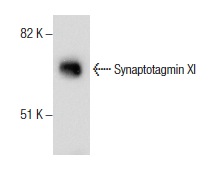
Western blot analysis of Synaptotagmin XI expression in mouse skeletal muscle tissue extract.| Product Name | Synaptotagmin XI Antibody (H-79) |
|---|---|
| Antibody Type | Primary Antibodies |
| Antigen Alias | epitope corresponding to amino acids 353-431 mapping at the C-terminus of Synaptotagmin XI of human origin |
| Modification Notes | Synaptotagmins are a large family of synaptic vesicle type III integral membrane proteins that function as regulators of both exocytosis and endocytosis and are involved in neurotransmitter secretion from small secretory vesicles. Synaptotagmin XI, also known as SYT11 (Synaptotagmin-11), is a 431 amino acid protein that localizes to the membrane and is expressed ubiquitously with highest expression in brain and lung. Like other Synaptotagmin proteins, Synaptotagmin XI is involved in the calcium-dependent exocytosis of secretory vesicles and is thought to act as a calcium sensor during vesicular trafficking. Synaptotagmin XI contains two C2 domains through which it can bind either three calcium ions or the zinc-finger protein Parkin (a juvenile Parkinson’s disease gene product), the latter of which causes the polyubiquitination and subsequent degradation of Synaptotagmin XI by the proteasome complex. Defects in the gene encoding Synaptotagmin XI are implicated in a number of neurological disorders, including schizophrenia and Parkinson’s disease. |
| Clonality | Polyclonal |
|---|---|
| Isotype | IgG |
| Host Species | Rabbit |
| Tested Applications | WBIPIFELISA |
| recommended for detection of Synaptotagmin XI of mouse, rat and human origin by WB, IP, IF and ELISA also reactive with additional species, including equine, canine, bovine, porcine and avian: |
|
| Species Reactivity | HumanMouseRat |
| Concentration | 1mg/ml |
| Purification | Affinity purified |
| Alternative Names | epitope corresponding to amino acids 353-431 mapping at the C-terminus of Synaptotagmin XI of human origin |
|---|---|
| Tissue Specificity | epitope corresponding to amino acids 353-431 mapping at the C-terminus of Synaptotagmin XI of human origin |
| Entrez Gene | 23208 |
|---|
Application
Western blot analysis of Synaptotagmin XI expression in mouse skeletal muscle tissue extract.| Application Notes | recommended for detection of Synaptotagmin XI of mouse, rat and human origin by WB, IP, IF and ELISA also reactive with additional species, including equine, canine, bovine, porcine and avian: |
|---|
| Form | Liquid |
|---|---|
| Storage Instructions | For short-term storage, store at 4° C. For long-term storage, aliquot and store at -20ºC or below. Avoid multiple freeze-thaw cycles. |
| Storage Buffer | phosphate buffered saline , pH 7.4, 150mM NaCl, 0.02% sodium azide and 50% glycerol. |


