Application
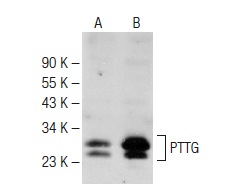
Western blot analysis of PTTG expression in Jurkat (A) and MOLT-4 (B) whole cell lysates.Application
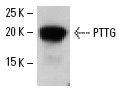
Western blot analysis of PTTG expression in rat pituitary tissue extract.| Product Name | PTTG Antibody (H-160) |
|---|---|
| Antibody Type | Primary Antibodies |
| Antigen Alias | epitope corresponding to amino acids 1-160 of PTTG of human origin |
| Modification Notes | The product of the oncogene PTTG, pituitary tumor transforming gene, is a human homolog of the anaphase-inhibitor vertebrate protein, securin. PTTG contains a basic amino-terminal domain and an acidic carboxy-terminal domain, which acts as a transactivation domain when fused to a heterologous DNA binding domain. Human PTTG is overexpressed in Jurkat and is also detected in human thymus, testis and placenta. PTTG is mainly expressed in the cytoplasm and is also partially localized to the nucleus. Vertebrate PTTG regulates the separin Esp1, which promotes chromatid separation, to overcome the cohesive forces that hold sister chromatids together. This regulatory function of PTTG suggests that defective regulation of cohesion may contribute to cancer by promoting chromosome instability. Although vertebrate PTTG shares cell-cycle functions with its yeast securin counterparts Pds1p and Cut2, none share sequence homology. |
| Clonality | Polyclonal |
|---|---|
| Isotype | IgG |
| Host Species | Rabbit |
| Tested Applications | WBIPIFELISA |
| recommended for detection of PTTG isoforms 1, 2 and 3 of mouse, rat and human origin by WB, IP, IF and ELISA also reactive with additional species, including canine and bovine: |
|
| Species Reactivity | HumanMouseRat |
| Concentration | 1mg/ml |
| Purification | Affinity purified |
| Alternative Names | epitope corresponding to amino acids 1-160 of PTTG of human origin |
|---|---|
| Tissue Specificity | epitope corresponding to amino acids 1-160 of PTTG of human origin |
| Entrez Gene | 9232 |
|---|
Application
Western blot analysis of PTTG expression in Jurkat (A) and MOLT-4 (B) whole cell lysates.
Application
Western blot analysis of PTTG expression in rat pituitary tissue extract.| Application Notes | recommended for detection of PTTG isoforms 1, 2 and 3 of mouse, rat and human origin by WB, IP, IF and ELISA also reactive with additional species, including canine and bovine: |
|---|
| Form | Liquid |
|---|---|
| Storage Instructions | For short-term storage, store at 4° C. For long-term storage, aliquot and store at -20ºC or below. Avoid multiple freeze-thaw cycles. |
| Storage Buffer | phosphate buffered saline , pH 7.4, 150mM NaCl, 0.02% sodium azide and 50% glycerol. |


