Application
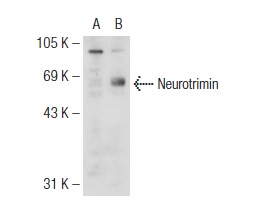
Western blot analysis of Neurotrimin expression in non-transfected: (A) and human Neurotrimin transfected: (B) 293T whole cell lysates.| Product Name | Neurotrimin Antibody (H-40) |
|---|---|
| Antibody Type | Primary Antibodies |
| Antigen Alias | epitope corresponding to amino acids 251-290 mapping near the C-terminus of Neurotrimin of human origin |
| Modification Notes | Cell adhesion molecules (CAMs) influence cell growth, differentiation, embryogenesis, immune response and cancer metastasis by networking information from the extracellular matrix to the cell. The four major families of cell adhesion molecules are immunoglobulin (Ig) superfamily (calcium-independent transmembrane glycoproteins), integrins (transmembrane non-covalently linked heterodimers of å and ∫ subunits), calcium-dependent cadherins and divalent cation-dependent selectins. Regulation of neuronal synaptic adhesion by CAMs has proven important for learning and memory. Proper embryonic morphogenic development is also heavily dependent on the regulation of cell adhesion molecules. Neurotrimin (hNT) is a neural cell adhesion molecule localizing to the cell membrane, where it acts as a lipid-anchor. Neurotrimin belongs to the IgLON family of proteins, a member of the larger immunoglobulin superfamily. |
| Clonality | Polyclonal |
|---|---|
| Isotype | IgG |
| Host Species | Rabbit |
| Tested Applications | WBIPIFELISA |
| recommended for detection of Neurotrimin of mouse, rat and human origin by WB, IP, IF and ELISA may cross-react with OBCAM also reactive with additional species, including equine, bovine and porcine: |
|
| Species Reactivity | HumanMouseRat |
| Concentration | 1mg/ml |
| Purification | Affinity purified |
| Alternative Names | epitope corresponding to amino acids 251-290 mapping near the C-terminus of Neurotrimin of human origin |
|---|---|
| Tissue Specificity | epitope corresponding to amino acids 251-290 mapping near the C-terminus of Neurotrimin of human origin |
| Entrez Gene | 50863 |
|---|
Application
Western blot analysis of Neurotrimin expression in non-transfected: (A) and human Neurotrimin transfected: (B) 293T whole cell lysates.| Application Notes | recommended for detection of Neurotrimin of mouse, rat and human origin by WB, IP, IF and ELISA may cross-react with OBCAM also reactive with additional species, including equine, bovine and porcine: |
|---|
| Form | Liquid |
|---|---|
| Storage Instructions | For short-term storage, store at 4° C. For long-term storage, aliquot and store at -20ºC or below. Avoid multiple freeze-thaw cycles. |
| Storage Buffer | phosphate buffered saline , pH 7.4, 150mM NaCl, 0.02% sodium azide and 50% glycerol. |


