Application
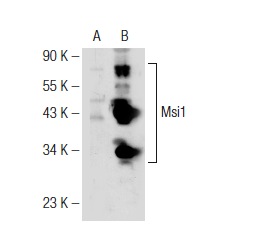
Western blot analysis of Msi1 expression in non-transfected: (A) and mouse Msi1 transfected: (B) 293 whole cell lysates.Application
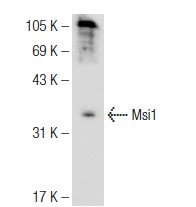
Western blot analysis of Msi1 expression in IMR-32 whole cell lysate.| Product Name | Msi1 Antibody (H-45) |
|---|---|
| Antibody Type | Primary Antibodies |
| Antigen Alias | epitope corresponding to amino acids 281-320 mapping near the C-terminus of Msi1 of human origin |
| Modification Notes | Musashi1 (Msi1) is an RNA-binding protein expressed in neural progenitor cells and neural stem cells (1). Msi1 is the mammalian homolog of Drosophila Musashi (1). The gene encoding human Msi1 encodes a 362 amino acid protein (2). In murine embryonic neural progenitor cells, Msi1 localizes to the cytoplasm and is downregulated during differentiation (1). Msi1 binds to NUMB, which encodes a membrane-associated antagonist of Notch signaling (3). Msi1 appears to function in the proliferation and maintenance of stem cell populations of the central nervous system (4). In addition to its usefulness as a marker for neural progenitor cells in normal human brains, Msi1 is also a marker for human gliomas (5). In rats, Msi1 is expressed in Sertoli cells of the testis and granulosa cells of the ovary (6). |
| Clonality | Polyclonal |
|---|---|
| Isotype | IgG |
| Host Species | Rabbit |
| Tested Applications | WBIPIFELISA |
| recommended for detection of Msi1 of mouse, rat and human origin by WB, IP, IF and ELISA also reactive with additional species, including canine, bovine and porcine: |
|
| Species Reactivity | HumanMouseRat |
| Concentration | 1mg/ml |
| Purification | Affinity purified |
| Alternative Names | epitope corresponding to amino acids 281-320 mapping near the C-terminus of Msi1 of human origin |
|---|---|
| Tissue Specificity | epitope corresponding to amino acids 281-320 mapping near the C-terminus of Msi1 of human origin |
| Entrez Gene | 4440 |
|---|
Application
Western blot analysis of Msi1 expression in non-transfected: (A) and mouse Msi1 transfected: (B) 293 whole cell lysates.
Application
Western blot analysis of Msi1 expression in IMR-32 whole cell lysate.| Application Notes | recommended for detection of Msi1 of mouse, rat and human origin by WB, IP, IF and ELISA also reactive with additional species, including canine, bovine and porcine: |
|---|
| Form | Liquid |
|---|---|
| Storage Instructions | For short-term storage, store at 4° C. For long-term storage, aliquot and store at -20ºC or below. Avoid multiple freeze-thaw cycles. |
| Storage Buffer | phosphate buffered saline , pH 7.4, 150mM NaCl, 0.02% sodium azide and 50% glycerol. |


