Application
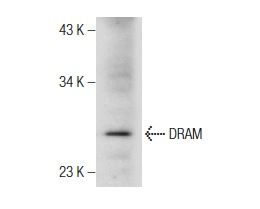
Western blot analysis of DRAM expression in K-562 whole cell lysate.| Product Name | DRAM Antibody (H-128) |
|---|---|
| Antibody Type | Primary Antibodies |
| Antigen Alias | epitope corresponding to amino acids 111-238; deletion 194-224 mapping at the C-terminus of DRAM of human origin |
| Modification Notes | DRAM (damage-regulated autophagy modulator) is a multi-pass membrane protein that belongs to the TMEM77 family of proteins and localizes to the lysosome membrane. DRAM is a highly conserved protein across many species and contains six transmembrane domains and an endoplasmic reticulum (ER) signal peptide. Its expression is induced by both p53 and p73, and it acts as a key player that is required (but not sufficient) for p53-induced autophagy and apoptosis. Although its expression is also induced by p73, DRAM is dispensable for p73-mediated apoptosis. As is suggested by its lysosomal localization, DRAM may participate in the degradation of proteins or in trafficking through the secretory pathway. In addition, DRAM expression is downregulated in human cancers, implying a profound role for DRAM in tumor development. |
| Clonality | Polyclonal |
|---|---|
| Isotype | IgG |
| Host Species | Rabbit |
| Tested Applications | WBIPIFELISA |
| recommended for detection of DRAM of mouse, rat and human origin by WB, IP, IF and ELISA also reactive with additional species, including equine, canine, bovine and porcine: |
|
| Species Reactivity | HumanMouseRat |
| Concentration | 1mg/ml |
| Purification | Affinity purified |
| Alternative Names | epitope corresponding to amino acids 111-238 deletion 194-224 mapping at the C-terminus of DRAM of human origin |
|---|---|
| Tissue Specificity | epitope corresponding to amino acids 111-238; deletion 194-224 mapping at the C-terminus of DRAM of human origin |
| Entrez Gene | 55332 |
|---|
Application
Western blot analysis of DRAM expression in K-562 whole cell lysate.| Application Notes | recommended for detection of DRAM of mouse, rat and human origin by WB, IP, IF and ELISA also reactive with additional species, including equine, canine, bovine and porcine: |
|---|
| Form | Liquid |
|---|---|
| Storage Instructions | For short-term storage, store at 4° C. For long-term storage, aliquot and store at -20ºC or below. Avoid multiple freeze-thaw cycles. |
| Storage Buffer | phosphate buffered saline , pH 7.4, 150mM NaCl, 0.02% sodium azide and 50% glycerol. |


