Application
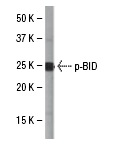
Western blot analysis of p-BID expression in Jurkate tissue extract.Application
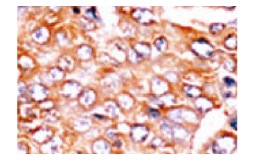
Immunoperoxidase staining of formalin fixed, paraffin-embedded human hepatocarcinoma tissue showing cytoplasmic staining.| Product Name | p-BID Antibody (Ser 65) |
|---|---|
| Antibody Type | Primary Antibodies |
| Antigen Alias | recommended for detection of Ser 65 phosphorylated BID of human origin by WB, IP, IF, IHC(P) and ELISA |
| Modification | Phosphoralated |
| Modification Notes | Members of the Bcl-2 family of proteins interact to regulate programmed cell death, or apoptosis. Various homodimers and heterodimers formed by proteins in this family can either promote or inhibit apoptosis. Bcl-2 blocks cell death following a variety of stimuli and confers a death-sparing effect on certain hematopoietic cell lines following growth factor withdrawal. Additional apop-totic inhibitors in this family include Bcl-x, Bcl-w, Mcl-1, Bag-1 and A1. Pro-apoptotic members of this family include Bax, Bad, Bak, Bik (NBK) and BID. BID contains a BH3 domain which allows it to dimerize with and counter the death repressor effects of Bcl-2. BID has also been shown to heterodimerize with Bcl-x and the death agonist Bax. BID is localized predominantly in the cytosol and is also present in membrane fractions. It is highly expressed in kidney and can also be detected in brain, spleen, liver, testis and lung. Upon DNA damage, human BID may be phosphorylated at Ser 65. |
| Clonality | Polyclonal |
|---|---|
| Isotype | IgG |
| Host Species | Rabbit |
| Tested Applications | WBIPIFIHCELISA |
| WB:1:500~1:2000 IP:1:100~1:500 IF:1:200~1:500 IHC:1:50~1:200 Notes:Optimal dilutions/concentrations should be determined by the researcher. |
|
| Species Reactivity | HumanMouseRat |
| Concentration | 1mg/ml |
| Purification | Affinity purified |
| Alternative Names | recommended for detection of Ser 65 phosphorylated BID of human origin by WB IP IF IHC(P) and ELISA |
|---|---|
| Tissue Specificity | recommended for detection of Ser 65 phosphorylated BID of human origin by WB, IP, IF, IHC(P) and ELISA |
| Entrez Gene | 637 |
|---|
Application
Western blot analysis of p-BID expression in Jurkate tissue extract.
Application
Immunoperoxidase staining of formalin fixed, paraffin-embedded human hepatocarcinoma tissue showing cytoplasmic staining.| Application Notes | WB:1:500~1:2000 IP:1:100~1:500 IF:1:200~1:500 IHC:1:50~1:200 Notes:Optimal dilutions/concentrations should be determined by the researcher. |
|---|
| Form | Liquid |
|---|---|
| Storage Instructions | For short-term storage, store at 4° C. For long-term storage, aliquot and store at -20ºC or below. Avoid multiple freeze-thaw cycles. |
| Storage Buffer | phosphate buffered saline , pH 7.4, 150mM NaCl, 0.02% sodium azide and 50% glycerol. |


