Application
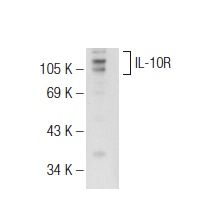
Western blot analysis of IL-10R expression in J774.A1 whole cell lysate.| Product Name | IL-10Rα Antibody (K-20) |
|---|---|
| Antibody Type | Primary Antibodies |
| Antigen Alias | epitope mapping at the N-terminus of IL-10Rα of mouse origin |
| Modification Notes | The IL-10 receptor, IL-10R, is a member of the class II subgroup of the cytokine receptor family and exhibits structural similarity to the interferon receptor. IL-10R is expressed in B cells and T helper cells, as well as in LPS-induced mouse fibroblasts. Overall, mouse IL-10R and human IL-10R share 60% sequence identity at the protein level. Stimulation with IL-10 leads to phosphorylation of JAK1 and Tyk 2 tyrosine kinases. The activated kinases phosphorylate the two tyrosine residues (Tyr 446 and Tyr 496) in the cytoplasmic domain of IL-10Rå. The phosphorylation of these two residues are required for proper function of IL-10R and activation of IL-10E1 signaling. IL-10R∫ is ubiquitously expressed and, in addition to forming the IL-10 heterodimeric receptor, it forms a heterodimeric receptor with an IL-22R subunit and an IL-28R subunit. IL-10R is constitutively expressed on human natural killer (NK) cells and the direct binding of IL-10 potentiates cytokine production by human NK cells. |
| Clonality | Polyclonal |
|---|---|
| Isotype | IgG |
| Host Species | Rabbit |
| Tested Applications | WBIPIFELISA |
| recommended for detection of IL-10Rα of mouse and rat origin by WB, IP, IF and ELISA: |
|
| Species Reactivity | HumanMouseRat |
| Concentration | 1mg/ml |
| Purification | Affinity purified |
| Alternative Names | epitope mapping at the N-terminus of IL-10R&alpha of mouse origin |
|---|---|
| Tissue Specificity | epitope mapping at the N-terminus of IL-10Rα of mouse origin |
| Entrez Gene | 16154 |
|---|
Application
Western blot analysis of IL-10R expression in J774.A1 whole cell lysate.| Application Notes | recommended for detection of IL-10Rα of mouse and rat origin by WB, IP, IF and ELISA: |
|---|
| Form | Liquid |
|---|---|
| Storage Instructions | For short-term storage, store at 4° C. For long-term storage, aliquot and store at -20ºC or below. Avoid multiple freeze-thaw cycles. |
| Storage Buffer | phosphate buffered saline , pH 7.4, 150mM NaCl, 0.02% sodium azide and 50% glycerol. |


