Application
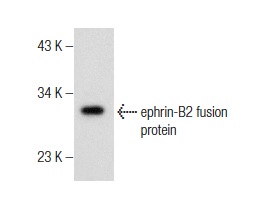
Western blot analysis of human recombinant ephrin-B2 fusion protein.| Product Name | ephrin-B2 Antibody (P-20) |
|---|---|
| Antibody Type | Primary Antibodies |
| Antigen Alias | epitope mapping within an extracellular domain of ephrin-B2 of human origin |
| Modification Notes | Ephrins, which act as ligands for Eph receptors, are cell-surface proteins which fall into two categories, ephrin-A and ephrin-B, based on their structure and function. Ephrin-B proteins are transmembrane and have conserved cytoplasmic tyrosine residues that are phosphorylated upon interaction with an EphB receptor. Eph receptors and ephrins exhibit complementary expression in many tissues during embryogenesis, indicating that bidirectional activation of Eph receptors and ephrin-B proteins may occur at expression domain interfaces. The transmembrane ligand ephrin-B2 and its receptor tyrosine kinase EphB4 are specifically expressed on arterial and venous endothelial cells, respectively. Bidirectional signals mediated by both proteins play an important role in vascular development. Ephrin-B2 is essential for the normal morphogenesis of the embryonic vasculature and is angiogenic in tumors. It has been identified as an important target of chemotherapeutic treatments. |
| Clonality | Polyclonal |
|---|---|
| Isotype | IgG |
| Host Species | Rabbit |
| Tested Applications | WBIPIFELISA |
| recommended for detection of ephrin-B2 of mouse, rat and human origin by WB, IP, IF and ELISA also reactive with additional species, including equine, canine, bovine, porcine and avian: |
|
| Species Reactivity | HumanMouseRat |
| Concentration | 1mg/ml |
| Purification | Affinity purified |
| Alternative Names | epitope mapping within an extracellular domain of ephrin-B2 of human origin |
|---|---|
| Tissue Specificity | epitope mapping within an extracellular domain of ephrin-B2 of human origin |
| Entrez Gene | 1948 |
|---|
Application
Western blot analysis of human recombinant ephrin-B2 fusion protein.| Application Notes | recommended for detection of ephrin-B2 of mouse, rat and human origin by WB, IP, IF and ELISA also reactive with additional species, including equine, canine, bovine, porcine and avian: |
|---|
| Form | Liquid |
|---|---|
| Storage Instructions | For short-term storage, store at 4° C. For long-term storage, aliquot and store at -20ºC or below. Avoid multiple freeze-thaw cycles. |
| Storage Buffer | phosphate buffered saline , pH 7.4, 150mM NaCl, 0.02% sodium azide and 50% glycerol. |


