Application
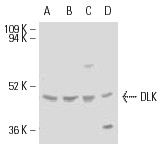
Western blot analysis of DLK expression in JAR (A), NIH/3T3 (B) and JEG-3 (C) whole cell lysates and rat placenta tissue extract (D).| Product Name | DLK Antibody (H-118) |
|---|---|
| Antibody Type | Primary Antibodies |
| Antigen Alias | epitope corresponding to amino acids 266-383 mapping at the C-terminus of DLK of human origin |
| Modification Notes | The human DLK gene maps to human chromosome 14q32 and encodes a 383 amino acid protein. DLK, also designated preadipocyte factor 1 (pref-1), ZOG, pG2 or FA1, is a transmembrane protein with six tandem EGF-like repeats in the putative extracellular domain, which is characteristic of the EGF-like protein family. DLK shares homology with invertebrate homeotic proteins, including Delta and Notch, which are proteins that mediate normal neural differentiation in Drosophila. In mammalian preadipocytes, multiple discrete forms of DLK protein are present due to N-linked glycosylation. DLK is expressed in tumors with neuroendocrine features, such as neuroblastoma and pheochromocytoma cell lines. Normal tissue expression is restricted to the adrenal gland and placenta. Protein-protein interaction between DLK proteins belonging to the same or to different cells, or the interaction between soluble and membrane DLK variants, may be important in regulation of DLK function. |
| Clonality | Polyclonal |
|---|---|
| Isotype | IgG |
| Host Species | Rabbit |
| Tested Applications | WBIPIFELISA |
| recommended for detection of DLK of mouse, rat and human origin by WB, IP, IF and ELISA also reactive with additional species, including equine, canine and porcine: |
|
| Species Reactivity | HumanMouseRat |
| Concentration | 1mg/ml |
| Purification | Affinity purified |
| Alternative Names | epitope corresponding to amino acids 266-383 mapping at the C-terminus of DLK of human origin |
|---|---|
| Tissue Specificity | epitope corresponding to amino acids 266-383 mapping at the C-terminus of DLK of human origin |
| Entrez Gene | 8788 |
|---|
Application
Western blot analysis of DLK expression in JAR (A), NIH/3T3 (B) and JEG-3 (C) whole cell lysates and rat placenta tissue extract (D).| Application Notes | recommended for detection of DLK of mouse, rat and human origin by WB, IP, IF and ELISA also reactive with additional species, including equine, canine and porcine: |
|---|
| Form | Liquid |
|---|---|
| Storage Instructions | For short-term storage, store at 4° C. For long-term storage, aliquot and store at -20ºC or below. Avoid multiple freeze-thaw cycles. |
| Storage Buffer | phosphate buffered saline , pH 7.4, 150mM NaCl, 0.02% sodium azide and 50% glycerol. |


