Application
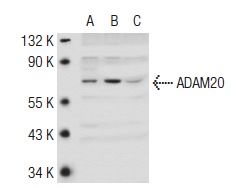
Western blot analysis of ADAM20 expression in non-transfected 293T: (A), human ADAM20 transfected 293T: (B) and HeLa (C) whole cell lysates.| Product Name | ADAM20 Antibody (H-105) |
|---|---|
| Antibody Type | Primary Antibodies |
| Antigen Alias | epitope corresponding to amino acids 241-345 mapping within an internal region of ADAM20 of human origin |
| Modification Notes | The ADAM (a disintegrin and metalloprotease) protein family, which includes more than 30 membrane-anchored, glycosylated, Zn2+ dependent proteases, plays a role in cell-cell and cell-matrix interface related processes, including fertilization, muscle fusion, secretion of tumor necrosis factor α (TNFα) and modulation of the neurogenic function of Notch and Delta. The ADAM proteins possess a signal-domain, a pro-domain, a metalloprotease domain, a disintegrin domain (integrin ligand), a cysteine-rich region, an epidermal growth factor-like domain, a transmembrane domain and a cytoplasmic tail. ADAMs are expressed in a wide range of mammalian tissues and several are abundantly expressed in the male reproductive tract. The ADAM20 and ADAM21 genes map to human chromosome 14q24.2, and both are abundantly expressed in testis. Specifically, ADAM21, also designated ADAM31 in mouse, is expressed on four types of specialized epithelia: the cauda epididymis, the vas deferens, the convoluted tubules of the kidney and the parietal cells of the stomach. |
| Clonality | Polyclonal |
|---|---|
| Isotype | IgG |
| Host Species | Rabbit |
| Tested Applications | WBIPIFELISA |
| recommended for detection of ADAM20 of human origin by WB, IP, IF and ELISA: |
|
| Species Reactivity | HumanMouseRat |
| Concentration | 1mg/ml |
| Purification | Affinity purified |
| Alternative Names | epitope corresponding to amino acids 241-345 mapping within an internal region of ADAM20 of human origin |
|---|---|
| Tissue Specificity | epitope corresponding to amino acids 241-345 mapping within an internal region of ADAM20 of human origin |
| Entrez Gene | 8748 |
|---|
Application
Western blot analysis of ADAM20 expression in non-transfected 293T: (A), human ADAM20 transfected 293T: (B) and HeLa (C) whole cell lysates.| Application Notes | recommended for detection of ADAM20 of human origin by WB, IP, IF and ELISA: |
|---|
| Form | Liquid |
|---|---|
| Storage Instructions | For short-term storage, store at 4° C. For long-term storage, aliquot and store at -20ºC or below. Avoid multiple freeze-thaw cycles. |
| Storage Buffer | phosphate buffered saline , pH 7.4, 150mM NaCl, 0.02% sodium azide and 50% glycerol. |


