Application
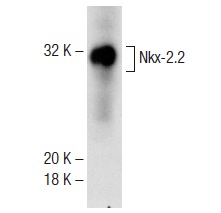
Western blot analysis of Nkx-2.2 expression in mouse brain tissue extract.| Product Name | Nkx-2.2 Antibody (H-60) |
|---|---|
| Antibody Type | Primary Antibodies |
| Antigen Alias | epitope corresponding to amino acids 214-273 mapping at the C-terminus of Nkx-2.2 of human origin |
| Modification Notes | Members of the NK-2 family of homeodomain proteins are key regulators of growth and development in several tissues, including brain, heart and pancreas. During neural development, sonic hedgehog (Shh) is known to control cell fate and mitogenesis, which is correlated with Shh dose-dependent expression of several genes, including Nkx-2.1, Nkx-2.2 and Nkx-2.9. Specifically, the Nkx-2.2 protein is responsible for directing ventral neuronal patterning in response to graded Shh signaling. In the pancreas, Nkx-2.2 is expressed in a, b and pancreatic polypeptide (PP) cells, but not in d cells. Nkx-2.2 expression is required for differentiation of pancreatic b cells, which produce insulin. Homozygous null mutations of the Nkx-2.2 gene in mice lead to severe hyperglycemia and death shortly after birth, which suggests that Nkx-2.2 may be an important therapeutic target for pancreatic diseases, including diabetes and cancer. |
| Clonality | Polyclonal |
|---|---|
| Isotype | IgG |
| Host Species | Rabbit |
| Tested Applications | WBIPIFELISAGSChIP |
| recommended for detection of Nkx-2.2 of mouse, rat and human origin by WB, IP, IF and ELISA also reactive with additional species, including equine, canine, bovine, porcine and avian: |
|
| Species Reactivity | HumanMouseRat |
| Concentration | 1mg/ml |
| Purification | Affinity purified |
| Alternative Names | epitope corresponding to amino acids 214-273 mapping at the C-terminus of Nkx-2.2 of human origin |
|---|---|
| Tissue Specificity | epitope corresponding to amino acids 214-273 mapping at the C-terminus of Nkx-2.2 of human origin |
| Entrez Gene | 4821 |
|---|
Application
Western blot analysis of Nkx-2.2 expression in mouse brain tissue extract.| Application Notes | recommended for detection of Nkx-2.2 of mouse, rat and human origin by WB, IP, IF and ELISA also reactive with additional species, including equine, canine, bovine, porcine and avian: |
|---|
| Form | Liquid |
|---|---|
| Storage Instructions | For short-term storage, store at 4° C. For long-term storage, aliquot and store at -20ºC or below. Avoid multiple freeze-thaw cycles. |
| Storage Buffer | phosphate buffered saline , pH 7.4, 150mM NaCl, 0.02% sodium azide and 50% glycerol. |


