
Application
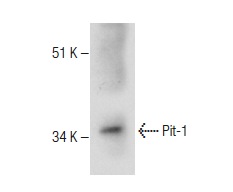
Western blot analysis of Pit-1 expression in rat pituitary tissue extract.Application
Western blot analysis of Pit-1 expression in F9 whole cell lysate.| Product Name | Pit-1 Antibody (X-7) |
|---|---|
| Antibody Type | Primary Antibodies |
| Antigen Alias | produced by immunization with full length Pit-1 polyhistidine tagged fusion protein of rat origin |
| Modification Notes | Transcriptional regulators play a critical role in development by mediating tissue- and cell-specific transcription. POU domain factors are transcriptional regulators characterized by a bipartite DNA binding domain, which consists of two highly conserved regions, tethered by a variable linker of 14-26 amino acids. Pit-1, also known as growth hormone factor-1 (GHF-1), a member of the POU homeodomain family, is essential for the normal development of the anterior pituitary gland, where it is required for the formation of somatotropes, lactotropes and thyrotropes. In somatotropes and lactotropes, Pit-1 activates the production of growth hormone and Prolactin, respectively. In addition, Pit-1 acts as a repressor of gene expression, which allows for the differentiation of specific cell types. Pit-1 is expressed as two alternatively spliced products, designated Pit-1a and Pit-1b, which differ in their trans-activation ability. Mutations in the Pit-1 gene are believed to result in combined pituitary hormone deficiency (CPHD) for growth hormone, Prolactin and thyroid stimulating hormone. The gene which encodes Pit-1 maps to human chromosome 3p11. |
| Clonality | Polyclonal |
|---|---|
| Isotype | IgG |
| Host Species | Rabbit |
| Tested Applications | WBIPIFELISAGSChIP |
| recommended for detection of Pit-1 of mouse, rat and human origin by WB, IP, IF and ELISA also reactive with additional species, including equine, canine, bovine and porcine: |
|
| Species Reactivity | HumanMouseRat |
| Concentration | 1mg/ml |
| Purification | Affinity purified |
| Alternative Names | produced by immunization with full length Pit-1 polyhistidine tagged fusion protein of rat origin |
|---|---|
| Tissue Specificity | produced by immunization with full length Pit-1 polyhistidine tagged fusion protein of rat origin |
| Entrez Gene | 5449 |
|---|
Application
Western blot analysis of Pit-1 expression in rat pituitary tissue extract.
Application
Western blot analysis of Pit-1 expression in F9 whole cell lysate.| Application Notes | recommended for detection of Pit-1 of mouse, rat and human origin by WB, IP, IF and ELISA also reactive with additional species, including equine, canine, bovine and porcine: |
|---|
| Form | Liquid |
|---|---|
| Storage Instructions | For short-term storage, store at 4° C. For long-term storage, aliquot and store at -20ºC or below. Avoid multiple freeze-thaw cycles. |
| Storage Buffer | phosphate buffered saline , pH 7.4, 150mM NaCl, 0.02% sodium azide and 50% glycerol. |


