Application
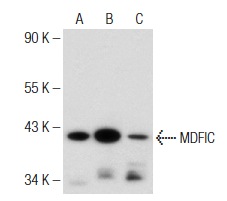
Western blot analysis of MDFIC expression in Hep G2 (A), Jurkat (B) and U-937 (C) nuclear extracts.Application
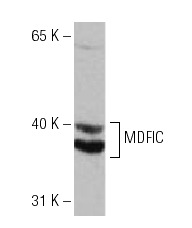
Western blot analysis of MDFIC expression in Hep G2 whole cell lysate.| Product Name | MDFIC Antibody (Z-25) |
|---|---|
| Antibody Type | Primary Antibodies |
| Antigen Alias | recommended for detection of MDFIC of human origin by WB, IP and ELISA |
| Modification Notes | MDFIC (MyoD family inhibitor domain-containing protein), also known as HIC, is a 355 amino acid protein that exists as two alternatively spliced isoforms, known as p40 and p32, which localize predominately to the nucleolus and cytoplasm, respectively. Expressed in prostate, thymus, spleen and small intestine, MDFIC functions to modulate the expression of viral genomes, specifically down-regulating the transcription of HIV-1 and up-regulating the expression of HTLV-1 (T-cell leukemia virus type I). Additionally, MDFIC is able to adjust the amount of ∫-catenin within the cell and may also function to regulate the Wnt and JNK signaling pathways. The gene encoding MDFIC maps to human chromosome 7, which houses over 1,000 genes and comprises nearly 5% of the human genome. Defects in some of the genes localized to chromosome 7 have been linked to Osteogenesis imperfecta, Williams-Beuren syndrome, Pendred syndrome, Lissencephaly, Citrullinemia and Shwachman-Diamond syndrome. |
| Clonality | Polyclonal |
|---|---|
| Isotype | IgG |
| Host Species | Rabbit |
| Tested Applications | WBIPELISA |
| WB:1:500~1:2000 IP:1:100~1:500 Notes:Optimal dilutions/concentrations should be determined by the researcher. |
|
| Species Reactivity | HumanMouseRat |
| Concentration | 1mg/ml |
| Purification | Affinity purified |
| Alternative Names | recommended for detection of MDFIC of human origin by WB IP and ELISA |
|---|---|
| Tissue Specificity | recommended for detection of MDFIC of human origin by WB, IP and ELISA |
| Entrez Gene | 29969 |
|---|
Application
Western blot analysis of MDFIC expression in Hep G2 (A), Jurkat (B) and U-937 (C) nuclear extracts.
Application
Western blot analysis of MDFIC expression in Hep G2 whole cell lysate.| Application Notes | WB:1:500~1:2000 IP:1:100~1:500 Notes:Optimal dilutions/concentrations should be determined by the researcher. |
|---|
| Form | Liquid |
|---|---|
| Storage Instructions | For short-term storage, store at 4° C. For long-term storage, aliquot and store at -20ºC or below. Avoid multiple freeze-thaw cycles. |
| Storage Buffer | phosphate buffered saline , pH 7.4, 150mM NaCl, 0.02% sodium azide and 50% glycerol. |


