Application
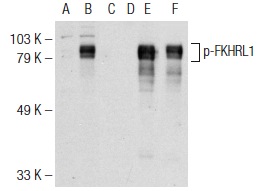
Antibodies tested include p-FKHRL1 (Ser 253): (A,B,C) and FKHRL1 (m): 293T Lysate: (D,E,F).Application
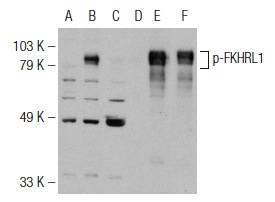
Antibodies tested include p-FKHRL1 (Thr 32)-R: (A,B,C) and FKHRL1 (m): 293T Lysate: (D,E,F).Application
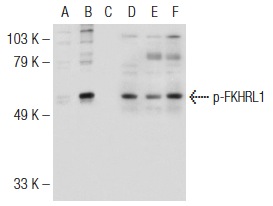
Antibodies tested include p-FKHRL1 (Ser 253): (A,B,C) and FKHRL1 (H-144): (D,E,F).Application
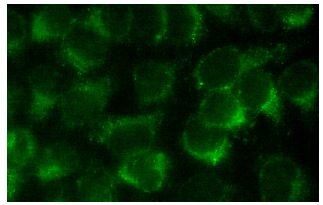
Immunofluorescence staining of methanol-fixed HeLa cells showing cytoplasmic localization.Application
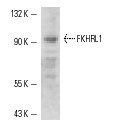
Western blot analysis of FKHRL1 expression in PDGF-treated NIH/3T3 whole cell lysate.Application
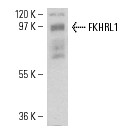
Western blot analysis of FKHRL1 expression in TE671 whole cell lysate.| Product Name | FKHRL1 Antibody (H-144) |
|---|---|
| Antibody Type | Primary Antibodies |
| Antigen Alias | epitope corresponding to amino acids 329-472 mapping near the C-terminus of FKHRL1 of human origin |
| Modification Notes | FKHR (for forkhead in rhabdomyosarcoma), FKHRL1, FKHRL1P1 and FKHRP1 compose a subfamily of the forkhead family of transcription factors. FKHR and FKHRL1 (also designated FOXO3A) are functional genes, whereas FKHRL1P1 and FKHRP1 appear to be processed pseudogenes. Transcriptional activation of FKHR proteins is regulated by the serine/threonine kinase Akt1, which phosphorylates FKHRL1, and results in FKHRL1 associating with 14-3-3 proteins and being retained in the cytoplasm. Induction of apoptosis or withdrawal of growth factors stimulates dephosphorylation and nuclear translocation of FKHR proteins, leading to FKHR-induced gene-specific transcriptional activation. Genetic mutations in FKHR genes, including the t(2;13) and t(1;3) translocations, are commonly found in alveolar rhabdomyosarcomas. These translocations result in the fusion of the N-terminus of Pax-3 or Pax-7, including the paired box and homeodomain DNA-binding domains, with the C-terminus of FKHR, which contains a transcriptional activation domain. The Pax-3/FKHR fusion protein appears to function as an oncogenic transcription factor that enhances the activation of normal Pax-3 target genes. Stem cell factor (SCF) promotes Mast Cell survival through inactivation of FKHRL1 and downregulation and phosphorylation of its target Bim (Bcl-2 interacting modulator of cell death). SCF induces a rapid and transient phosphorylation of Akt (protein kinase B) and FKHRL1. FKHRL1 maintains neutrophil vitality during inflammation by suppressing FAS ligand. |
| Clonality | Polyclonal |
|---|---|
| Isotype | IgG |
| Host Species | Rabbit |
| Tested Applications | WBIPIFELISAGSChIP |
| recommended for detection of FKHRL1 of mouse, rat and human origin by WB, IP, IF and ELISA also reactive with additional species, including equine, canine, bovine, porcine and avian: |
|
| Species Reactivity | HumanMouseRat |
| Concentration | 1mg/ml |
| Purification | Affinity purified |
| Alternative Names | epitope corresponding to amino acids 329-472 mapping near the C-terminus of FKHRL1 of human origin |
|---|---|
| Tissue Specificity | epitope corresponding to amino acids 329-472 mapping near the C-terminus of FKHRL1 of human origin |
| Entrez Gene | 2309 |
|---|
Application
Antibodies tested include p-FKHRL1 (Ser 253): (A,B,C) and FKHRL1 (m): 293T Lysate: (D,E,F).
Application
Antibodies tested include p-FKHRL1 (Thr 32)-R: (A,B,C) and FKHRL1 (m): 293T Lysate: (D,E,F).
Application
Antibodies tested include p-FKHRL1 (Ser 253): (A,B,C) and FKHRL1 (H-144): (D,E,F).
Application
Immunofluorescence staining of methanol-fixed HeLa cells showing cytoplasmic localization.
Application
Western blot analysis of FKHRL1 expression in PDGF-treated NIH/3T3 whole cell lysate.
Application
Western blot analysis of FKHRL1 expression in TE671 whole cell lysate.| Application Notes | recommended for detection of FKHRL1 of mouse, rat and human origin by WB, IP, IF and ELISA also reactive with additional species, including equine, canine, bovine, porcine and avian: |
|---|
| Form | Liquid |
|---|---|
| Storage Instructions | For short-term storage, store at 4° C. For long-term storage, aliquot and store at -20ºC or below. Avoid multiple freeze-thaw cycles. |
| Storage Buffer | phosphate buffered saline , pH 7.4, 150mM NaCl, 0.02% sodium azide and 50% glycerol. |


