Application
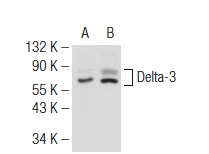
Western blot analysis of Delta-3 expression in non-transfected: (A) and human Delta-3 transfected: (B) 293T whole cell lysates.| Product Name | Delta-3 Antibody (H-110) |
|---|---|
| Antibody Type | Primary Antibodies |
| Antigen Alias | epitope corresponding to amino acids 121-230 mapping within an N-terminal extracellular domain of Delta-3 of human origin |
| Modification Notes | The LIN-12/Notch family of transmembrane receptors is believed to play a central role in development by regulating cell fate decisions. Notch can be activated by several ligands including Jagged1, Jagged2 and the Delta family of proteins. Delta-3, also known as DLL3 (Drosophila Delta homolog 3) or SCDO1, is a single-pass type I membrane protein that can bind to and activate Notch receptors. Required to divert neurons along their specified differentiation pathways, Delta-3 can inhibit primary neurogenesis and assist in forming somite boundaries during paraxial mesoderm segmentation. Delta-3 contains six EGF-like domains, one transmembrane domain and one DSL domain which is required for proper binding to the Notch receptor. Ubiquination by Skeletrophin (also known as MIB2, mindbomb homolog 2) leads to endocytosis and subsequent degradation of Delta-3. Defects in the gene encoding Delta-3 are the cause of autosomal recessive spondylocostal dysostosis type 1 (SCDO1), a condition characterized by rib fusions and multiple hemivertebrae. |
| Clonality | Polyclonal |
|---|---|
| Isotype | IgG |
| Host Species | Rabbit |
| Tested Applications | WBIPIFELISA |
| recommended for detection of Delta-3 of human and, to a lesser extent, mouse and rat origin by WB, IP, IF and ELISA also reactive with additional species, including canine, bovine and porcine: |
|
| Species Reactivity | HumanMouseRat |
| Concentration | 1mg/ml |
| Purification | Affinity purified |
| Alternative Names | epitope corresponding to amino acids 121-230 mapping within an N-terminal extracellular domain of Delta-3 of human origin |
|---|---|
| Tissue Specificity | epitope corresponding to amino acids 121-230 mapping within an N-terminal extracellular domain of Delta-3 of human origin |
| Entrez Gene | 10683 |
|---|
Application
Western blot analysis of Delta-3 expression in non-transfected: (A) and human Delta-3 transfected: (B) 293T whole cell lysates.| Application Notes | recommended for detection of Delta-3 of human and, to a lesser extent, mouse and rat origin by WB, IP, IF and ELISA also reactive with additional species, including canine, bovine and porcine: |
|---|
| Form | Liquid |
|---|---|
| Storage Instructions | For short-term storage, store at 4° C. For long-term storage, aliquot and store at -20ºC or below. Avoid multiple freeze-thaw cycles. |
| Storage Buffer | phosphate buffered saline , pH 7.4, 150mM NaCl, 0.02% sodium azide and 50% glycerol. |


