Application
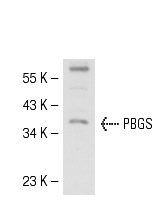
Western blot analysis of PBGS expression in HEL 92.1.7 whole cell lysate.Application
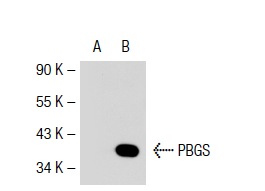
Western blot analysis of PBGS expression in non-transfected: (A) and mouse PBGS transfected: (B) 293T whole cell lysates.| Product Name | PBGS Antibody (H-300) |
|---|---|
| Antibody Type | Primary Antibodies |
| Antigen Alias | raised against amino acids 1-300 mapping at the N-terminus of PBGS of human origin |
| Modification Notes | PGBS (porphobilinogen synthase), an enzyme that belongs to the ALADH family, is composed of eight identical subunits and catalyzes the condensation of two molecules of ∂-aminolevulinate to form porphobilinogen, a precursor of heme, cytochromes and other hemoproteins. It also catalyzes the second step in the porphyrin and heme biosynthetic pathway in which zinc is essential for enzymatic activity. PGBS is inhibited by lead. A defect in the gene encoding PGBS, ALAD, can cause increased sensitivity to lead poisoning and acute hepatic porphyria, a group of inherited disorders caused by partial enzyme defects in heme biosynthesis, which includes acute intermittent porphyria, variegate porphyria and hereditary coproporphyria. There are two common alleles of ALAD, ALAD*2 and ALAD*1. When exposed to environmental lead, individuals heterozygous or homozygous for ALAD*2 Asn 59 have significantly higher blood lead levels than do ALAD*1 Lys 59 homozygotes. |
| Clonality | Polyclonal |
|---|---|
| Isotype | IgG |
| Host Species | Rabbit |
| Tested Applications | WBIPIFELISA |
| recommended for detection of PBGS of mouse, rat and human origin by WB, IP, IF and ELISA also reactive with additional species, including equine, canine and bovine: |
|
| Species Reactivity | HumanMouseRat |
| Concentration | 1mg/ml |
| Purification | Affinity purified |
| Alternative Names | raised against amino acids 1-300 mapping at the N-terminus of PBGS of human origin |
|---|---|
| Tissue Specificity | raised against amino acids 1-300 mapping at the N-terminus of PBGS of human origin |
| Entrez Gene | 210 |
|---|
Application
Western blot analysis of PBGS expression in HEL 92.1.7 whole cell lysate.
Application
Western blot analysis of PBGS expression in non-transfected: (A) and mouse PBGS transfected: (B) 293T whole cell lysates.| Application Notes | recommended for detection of PBGS of mouse, rat and human origin by WB, IP, IF and ELISA also reactive with additional species, including equine, canine and bovine: |
|---|
| Form | Liquid |
|---|---|
| Storage Instructions | For short-term storage, store at 4° C. For long-term storage, aliquot and store at -20ºC or below. Avoid multiple freeze-thaw cycles. |
| Storage Buffer | phosphate buffered saline , pH 7.4, 150mM NaCl, 0.02% sodium azide and 50% glycerol. |


