Application
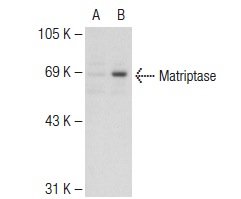
Western blot analysis of Matriptase expression in non-transfected: (A) and human Matriptase transfected: (B) 293T whole cell lysates.| Product Name | Matriptase Antibody (H-270) |
|---|---|
| Antibody Type | Primary Antibodies |
| Antigen Alias | epitope corresponding to amino acids 81-350 mapping within an N-terminal extracellular domain of Matriptase of human origin |
| Modification Notes | Matriptase (also known as MT-SP1, ST14, prostamin and epithin) is a tumor-associated type II transmembrane serine protease that is highly expressed in many human cancer-derived cell lines and is implicated in extracellular matrix re-modeling, tumor growth, and metastasis (1-7). Matriptase performs pleiotropic functions in the development of the epidermis, hair follicles, and cellular immune system (3). Sphingosine 1-phosphate (S1P, SPP), present in serum-derived lipoproteins, activates matriptase (5) while matriptase activates both urokinase-type plasminogen activator and hepatocyte growth factor (HGF) (6). Hepatocyte growth factor activator inhibitor type 1 (HAI-1) is a Kunitz-type serine protease inhibitor identified as a strong inhibitor of matriptase and HGF (7). Advanced-stage ovarian tumors that express matriptase are more likely to do so in the absence of its inhibitor, HAI-1, indicating that an imbalance in the matriptase:HAI-1 ratio could be important in the development of advanced disease (2). |
| Clonality | Polyclonal |
|---|---|
| Isotype | IgG |
| Host Species | Rabbit |
| Tested Applications | WBIPIFELISA |
| recommended for detection of Matriptase of mouse, rat and human origin by WB, IP, IF and ELISA: |
|
| Species Reactivity | HumanMouseRat |
| Concentration | 1mg/ml |
| Purification | Affinity purified |
| Alternative Names | epitope corresponding to amino acids 81-350 mapping within an N-terminal extracellular domain of Matriptase of human origin |
|---|---|
| Tissue Specificity | epitope corresponding to amino acids 81-350 mapping within an N-terminal extracellular domain of Matriptase of human origin |
| Entrez Gene | 6768 |
|---|
Application
Western blot analysis of Matriptase expression in non-transfected: (A) and human Matriptase transfected: (B) 293T whole cell lysates.| Application Notes | recommended for detection of Matriptase of mouse, rat and human origin by WB, IP, IF and ELISA: |
|---|
| Form | Liquid |
|---|---|
| Storage Instructions | For short-term storage, store at 4° C. For long-term storage, aliquot and store at -20ºC or below. Avoid multiple freeze-thaw cycles. |
| Storage Buffer | phosphate buffered saline , pH 7.4, 150mM NaCl, 0.02% sodium azide and 50% glycerol. |


