Application
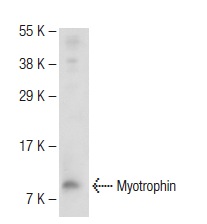
Western blot analysis of Myotrophin expression in HeLa whole cell lysate.Application
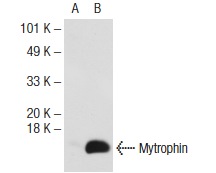
Western blot analysis of Myotrophin expression in non-transfected: (A) and human Myotrophin transfected: (B) 293T whole cell lysates.| Product Name | Myotrophin Antibody (FL-118) |
|---|---|
| Antibody Type | Primary Antibodies |
| Antigen Alias | epitope corresponding to amino acids 1-118 representing full length Myotrophin of human origin |
| Modification Notes | Myotrophin (V-1 protein) is a ubiquitously expressed cytoplasmic protein that can translocate to the nucleus during sustained NF˚B activation. The gene encoding for this protein localizes to chromosome 7q33. Myotrophin may be involved in cerebellar morphogenesis and contains an acetylated N-terminus and 2.5 internal 33 amino acid ankyrin repeats. It is important in the differentiation of cerebellar neurons, particularly of granule cells. The 117 amino acid protein has been associated with, and able to induce, cardiac hypertrophy. Myotrophin increases protooncogene, ANF and ∫-Myosin heavy chain transcript levels. Myotrophin is upregulated when myocytes undergo cyclic stretch or are treated with tumor necrosis factor å (TNFå) or interleukin-1∫. Highest levels of Myotrophin are detected in brain and lowest levels in skeletal muscle. |
| Clonality | Polyclonal |
|---|---|
| Isotype | IgG |
| Host Species | Rabbit |
| Tested Applications | WBIPIFELISA |
| recommended for detection of Myotrophin of mouse, rat and human origin by WB, IP, IF and ELISA also reactive with additional species, including equine, canine, bovine, porcine and avian: |
|
| Species Reactivity | HumanMouseRat |
| Concentration | 1mg/ml |
| Purification | Affinity purified |
| Alternative Names | epitope corresponding to amino acids 1-118 representing full length Myotrophin of human origin |
|---|---|
| Tissue Specificity | epitope corresponding to amino acids 1-118 representing full length Myotrophin of human origin |
| Entrez Gene | 136319 |
|---|
Application
Western blot analysis of Myotrophin expression in HeLa whole cell lysate.
Application
Western blot analysis of Myotrophin expression in non-transfected: (A) and human Myotrophin transfected: (B) 293T whole cell lysates.| Application Notes | recommended for detection of Myotrophin of mouse, rat and human origin by WB, IP, IF and ELISA also reactive with additional species, including equine, canine, bovine, porcine and avian: |
|---|
| Form | Liquid |
|---|---|
| Storage Instructions | For short-term storage, store at 4° C. For long-term storage, aliquot and store at -20ºC or below. Avoid multiple freeze-thaw cycles. |
| Storage Buffer | phosphate buffered saline , pH 7.4, 150mM NaCl, 0.02% sodium azide and 50% glycerol. |


