Application
Immunoperoxidase staining of formalin fixed, paraffin-embedded human duodenum tissue showing cytoplasmic staining of glandular cells.Application
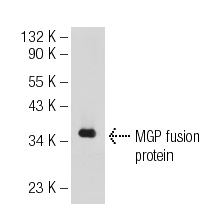
Western blot analysis of full length human MGP fusion protein.| Product Name | MGP Antibody (FL-103) |
|---|---|
| Antibody Type | Primary Antibodies |
| Antigen Alias | epitope corresponding to amino acids 1-103 representing full length MGP of human origin |
| Modification Notes | Matrix Gla protein, or MGP, is involved in regulating calcification in the extracellular matrix, in particular in cartilage and arteries. MGP is a vitamin K-dependent protein containing five to six residues of g-carboxy-glutamic acid (Gla), a Ca2+ binding amino acid requiring vitamin K-dependent g carboxylase for its formation. In humans MGP is an 84 residue protein along with a 19 amino acid transmembrane signal peptide. A shortened 77 residue form of MGP is found in human bone extracts, likely formed by COOH-terminal processing by carboxypeptidase B-like enzymatic activity. High levels of ex-pression occur in heart, kidney and lung, and over-expression of MGP occurs in the breast cancer cell line 600 PEI. Retinoic acid induces MGP expression in chondrocytes, fibroblasts and osteoblasts. Mutations in the gene coding for MGP can cause Keutel syndrome (KS), associated with abnormal cartilage calcification, substantiating the role of MGP in extracellular matrix calcification regulation. MGP can bind Vitronectin and Fibronectin via its C-terminus; phosphorlyation of MGP occurs near the N-terminus at three serine residues, which are part of a tandemly repeated Ser-X-Glu sequence. |
| Clonality | Polyclonal |
|---|---|
| Isotype | IgG |
| Host Species | Rabbit |
| Tested Applications | WBIPIFIHCELISA |
| recommended for detection of MGP of mouse, rat and human origin by WB, IP, IF, IHC(P) and ELISA also reactive with additional species, including canine: |
|
| Species Reactivity | HumanMouseRat |
| Concentration | 1mg/ml |
| Purification | Affinity purified |
| Alternative Names | epitope corresponding to amino acids 1-103 representing full length MGP of human origin |
|---|---|
| Tissue Specificity | epitope corresponding to amino acids 1-103 representing full length MGP of human origin |
| Entrez Gene | 4256 |
|---|
Application
Immunoperoxidase staining of formalin fixed, paraffin-embedded human duodenum tissue showing cytoplasmic staining of glandular cells.
Application
Western blot analysis of full length human MGP fusion protein.| Application Notes | recommended for detection of MGP of mouse, rat and human origin by WB, IP, IF, IHC(P) and ELISA also reactive with additional species, including canine: |
|---|
| Form | Liquid |
|---|---|
| Storage Instructions | For short-term storage, store at 4° C. For long-term storage, aliquot and store at -20ºC or below. Avoid multiple freeze-thaw cycles. |
| Storage Buffer | phosphate buffered saline , pH 7.4, 150mM NaCl, 0.02% sodium azide and 50% glycerol. |


