Application
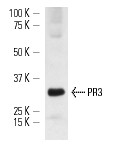
Western blot analysis of PR3 expression in SH-SY5Y whole cell lysate.| Product Name | PR3 Antibody (M-60) |
|---|---|
| Antibody Type | Primary Antibodies |
| Antigen Alias | epitope corresponding to amino acids 91-150 mapping within an internal region of PR3 of mouse origin |
| Modification Notes | The major features of Wegener granulomatosis are necrotizing granulomatous lesions, which most often affect the upper and lower airways and are associated with vasculitis, necrotizing glomerulonephritis and pulmonary capillaritis. The antigen responsible for this disease is Proteinase 3 (PR3, P29 or myeloblastin), which is one of the antibiotic proteins of neutrophilic granules belonging to the serine protease family. It is closely related to two others: Neutrophil Elastase and azurocidin. All three genes are expressed coordinately and their protein products are packaged together into azurophil granules during neutrophil differentiation. PR3 is a neutrophil protein which is able to cleave elastin and is involved in proliferation of human leukemia cells. PR3 is expressed specifically in immature myeloid cells and is a G-CSF-responsive protein critical to factor-independent growth. The genes for all three of the related serine protease family members are located in a cluster on the tip of the short arm of human chromosome 19. |
| Clonality | Polyclonal |
|---|---|
| Isotype | IgG |
| Host Species | Rabbit |
| Tested Applications | WBIPIFELISA |
| recommended for detection of precursor and mature forms of PR3 of mouse, rat and human origin by WB, IP, IF and ELISA: |
|
| Species Reactivity | HumanMouseRat |
| Concentration | 1mg/ml |
| Purification | Affinity purified |
| Alternative Names | epitope corresponding to amino acids 91-150 mapping within an internal region of PR3 of mouse origin |
|---|---|
| Tissue Specificity | epitope corresponding to amino acids 91-150 mapping within an internal region of PR3 of mouse origin |
| Entrez Gene | 19152 |
|---|
Application
Western blot analysis of PR3 expression in SH-SY5Y whole cell lysate.| Application Notes | recommended for detection of precursor and mature forms of PR3 of mouse, rat and human origin by WB, IP, IF and ELISA: |
|---|
| Form | Liquid |
|---|---|
| Storage Instructions | For short-term storage, store at 4° C. For long-term storage, aliquot and store at -20ºC or below. Avoid multiple freeze-thaw cycles. |
| Storage Buffer | phosphate buffered saline , pH 7.4, 150mM NaCl, 0.02% sodium azide and 50% glycerol. |


