Application
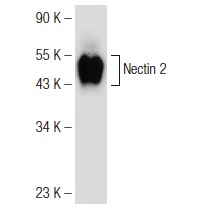
Western blot analysis of human recombinant Nectin 2.Application
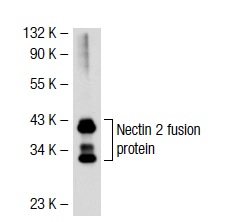
Western blot analysis of human recombinant Nectin 2 fusion protein.| Product Name | Nectin 2 Antibody (H-108) |
|---|---|
| Antibody Type | Primary Antibodies |
| Antigen Alias | epitope corresponding to amino acids 28-135 mapping near the N-terminus of Nectin 2 of human origin |
| Modification Notes | Nectin is a Ca2+-independent homophilic cell adhesion molecule that belongs to the immunoglobulin superfamily. Human nectin is identical to the poliovirus receptor-related protein (PRR) and has been identified as the å-herpesvirus entry mediator. Nectin constitutes a family consisting of at least Nectin 1, 2 and 3; each member has two or three splicing variants. Nectin 2, also designated PRR2/HveB, is ubquitously expressed, with the highest levels of expression in some human neuronal cell lines, fibroblastic cells, keratinocytes and primary activated T lymphocytes. Nectin 2 has two splicing variants, Nectin 2å (short form) and 2∂ (long form). Both Nectin 2å and 2∂ have a C-terminal conserved motif (E/A-X-Y-V). This motif interacts with the PDZ domain of the F-Actin-binding protein afadin, through which it is linked to the Actin cytoskeleton. The extracellular regions of the splicing variants are identical, but their transmembrane regions and cytoplasmic regions are unique. Nectin 2 mediates the entry of three mutant herpes simplex virus type 1 (HSV-1) strains that do not use HveA as co-receptor, but not wildtype HSV-1 strains. Nectin 2 also mediates the entry of HSV-2 and pseudorabies virus, but not bovine herpes virus type 1. Nectin 2∂ is tyrosine phosphorylated in response to cell-cell adhesion. |
| Clonality | Polyclonal |
|---|---|
| Isotype | IgG |
| Host Species | Rabbit |
| Tested Applications | WBIPIFELISA |
| recommended for detection of Nectin 2 of human and, to a lesser extent, mouse and rat origin by WB, IP, IF and ELISA: |
|
| Species Reactivity | HumanMouseRat |
| Concentration | 1mg/ml |
| Purification | Affinity purified |
| Alternative Names | epitope corresponding to amino acids 28-135 mapping near the N-terminus of Nectin 2 of human origin |
|---|---|
| Tissue Specificity | epitope corresponding to amino acids 28-135 mapping near the N-terminus of Nectin 2 of human origin |
| Entrez Gene | 5819 |
|---|
Application
Western blot analysis of human recombinant Nectin 2.
Application
Western blot analysis of human recombinant Nectin 2 fusion protein.| Application Notes | recommended for detection of Nectin 2 of human and, to a lesser extent, mouse and rat origin by WB, IP, IF and ELISA: |
|---|
| Form | Liquid |
|---|---|
| Storage Instructions | For short-term storage, store at 4° C. For long-term storage, aliquot and store at -20ºC or below. Avoid multiple freeze-thaw cycles. |
| Storage Buffer | phosphate buffered saline , pH 7.4, 150mM NaCl, 0.02% sodium azide and 50% glycerol. |


