Application
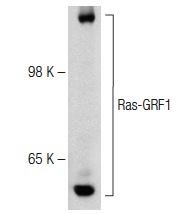
Western blot analysis of Ras-GRF1 expression in rat brain tissue extract.Application
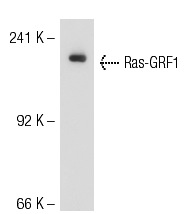
Western blot analysis of Ras-GRF1 expression in HeLa whole cell lysate.| Product Name | Ras-GRF1 Antibody (C-20) |
|---|---|
| Antibody Type | Primary Antibodies |
| Antigen Alias | epitope mapping near the C-terminus of Ras-GRF1 of rat origin |
| Modification Notes | A critical step in signal transduction responses to stimulation of cell surface receptors by their ligands involves the accumulation of Ras proteins in their active GTP-bound state (1,2). To reach their active GTP-bound state, Ras proteins must first release bound GDP, a rate limiting step mediated by a guanine nucleotide releasing factor (GRF) (3,4). The mammalian Ras p21 GRF protein has been designated Ras-GRF1 p140 (5). Ras-GRF1 accelerates release of GDP from H- and N-Ras p21 protein in vitro, but not from the related Ral A or CDC42Hs GTP-binding proteins. Of interest, a region mapping within the amino terminal domain of Ras-GRF1 is similar to both the human breakpoint cluster protein, Bcr, and the Dbl proto-oncogene product, a guanine nucleotide releasing factor for CDC42Hs (6,7). Ras-GRF2 p135 has also been identified. Ras-GRF2 p135 is highly homologous to Ras-GRF1 p140 except in the region between the REM and CDC25 domains (8) and appears to function similarly to Ras-GRF1 p140. |
| Clonality | Polyclonal |
|---|---|
| Isotype | IgG |
| Host Species | Rabbit |
| Tested Applications | WBIPIFELISA |
| recommended for detection of Ras-GRF1 p140 of mouse, rat and human origin by WB, IP, IF and ELISA also reactive with additional species, including equine, bovine and porcine: |
|
| Species Reactivity | HumanMouseRat |
| Concentration | 1mg/ml |
| Purification | Affinity purified |
| Alternative Names | epitope mapping near the C-terminus of Ras-GRF1 of rat origin |
|---|---|
| Tissue Specificity | epitope mapping near the C-terminus of Ras-GRF1 of rat origin |
| Entrez Gene | 5923 |
|---|
Application
Western blot analysis of Ras-GRF1 expression in rat brain tissue extract.
Application
Western blot analysis of Ras-GRF1 expression in HeLa whole cell lysate.| Application Notes | recommended for detection of Ras-GRF1 p140 of mouse, rat and human origin by WB, IP, IF and ELISA also reactive with additional species, including equine, bovine and porcine: |
|---|
| Form | Liquid |
|---|---|
| Storage Instructions | For short-term storage, store at 4° C. For long-term storage, aliquot and store at -20ºC or below. Avoid multiple freeze-thaw cycles. |
| Storage Buffer | phosphate buffered saline , pH 7.4, 150mM NaCl, 0.02% sodium azide and 50% glycerol. |


