Application
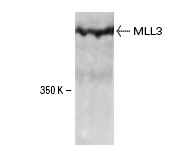
Western blot analysis of MLL3 expression in 293 whole cell lysate.| Product Name | MLL3 Antibody (C-16) |
|---|---|
| Antibody Type | Primary Antibodies |
| Antigen Alias | recommended for detection of MLL3 of human origin by WB, IP and ELISA |
| Modification Notes | The mixed lineage leukemia (MLL) gene family comprise a group of Histone H3 lysine 4 (H3K4) methyltransferases within the larger SET1 family. The founding member MLL commonly undergoes translocations in infantile leukemia and displays increased expression in some adult myeloid leukemias. MLL2, also designated ALR, exists within a complex of proteins. MLL2 is important for mouse embryonic development and may be involved in adhesion-related cytoskeletal events affecting cell growth and survival. The MLL2 gene maps to the human locus 19q13.1, which is a frequent target of rearrangement or amplification in solid tumors. MLL3 or its paralogue MLL4 associate with activating signal cointegrator-2 (ASC-2), which regulates ligand-dependent H3K4 trimethylation and expression of LXR-target genes. MLL3 maps to a location on human chromosome 7 that is often deleted in myeloid disorders. MLL3 also exhibits higher expression in peripheral blood, placenta, pancreas, testis, and fetal thymus. MLL5 localizes to the nucleus and forms intranuclear protein complexes, which may regulate chromatin remodeling and cellular growth suppression. The gene encoding human MLL5 lies within chromosome band 7q22, a region deleted in cytogenetic aberrations of acute myeloid malignancies. |
| Clonality | Polyclonal |
|---|---|
| Isotype | IgG |
| Host Species | Rabbit |
| Tested Applications | WBIPELISA |
| WB:1:500~1:2000 IP:1:100~1:500 Notes:Optimal dilutions/concentrations should be determined by the researcher. |
|
| Species Reactivity | HumanMouseRat |
| Concentration | 1mg/ml |
| Purification | Affinity purified |
| Alternative Names | recommended for detection of MLL3 of human origin by WB IP and ELISA |
|---|---|
| Tissue Specificity | recommended for detection of MLL3 of human origin by WB, IP and ELISA |
| Entrez Gene | 58508 |
|---|
Application
Western blot analysis of MLL3 expression in 293 whole cell lysate.| Application Notes | WB:1:500~1:2000 IP:1:100~1:500 Notes:Optimal dilutions/concentrations should be determined by the researcher. |
|---|
| Form | Liquid |
|---|---|
| Storage Instructions | For short-term storage, store at 4° C. For long-term storage, aliquot and store at -20ºC or below. Avoid multiple freeze-thaw cycles. |
| Storage Buffer | phosphate buffered saline , pH 7.4, 150mM NaCl, 0.02% sodium azide and 50% glycerol. |


