Application
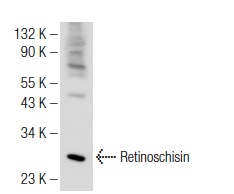
Western blot analysis of Retinoschisin expression in 293T whole cell lysate.| Product Name | Retinoschisin Antibody (H-65) |
|---|---|
| Antibody Type | Primary Antibodies |
| Antigen Alias | epitope corresponding to amino acids 126-190 mapping near the C-terminus of Retinoschisin of human origin |
| Modification Notes | X-linked juvenile retinoschisis (XLRS), the most common form of early onset macular degeneration in males, is characterized by delamination of the inner retinal layers and severe loss of vision. XLRS is caused by over 125 different mutations in the RS1 gene, which encodes the discoidin domain-containing protein Retinoschisin. Retinoschisin functions as a cell adhesion protein that maintains the cellular organization and synaptic structure of the retina. It is secreted from retinal tissues, specifically photoreceptor and bipolar cells, as an octamer, the subunits of which are joined together by Cys 59-Cys 223 intermolecular disulfide bonds. The interaction of cysteine residues in the Retinoschisin protein are critical for proper folding and subunit assembly. Misfolding of the discoidin domain, defective disulfide-linked subunit assembly and inability of Retinoschisin to insert into the endoplasmic reticulum membrane are responsible for the loss of function of Retinoschisin and the pathogenesis of XLRS. |
| Clonality | Polyclonal |
|---|---|
| Isotype | IgG |
| Host Species | Rabbit |
| Tested Applications | WBIPIFELISA |
| recommended for detection of Retinoschisin of mouse, rat and human origin by WB, IP, IF and ELISA also reactive with additional species, including equine, canine, bovine and avian: |
|
| Species Reactivity | HumanMouseRat |
| Concentration | 1mg/ml |
| Purification | Affinity purified |
| Alternative Names | epitope corresponding to amino acids 126-190 mapping near the C-terminus of Retinoschisin of human origin |
|---|---|
| Tissue Specificity | epitope corresponding to amino acids 126-190 mapping near the C-terminus of Retinoschisin of human origin |
| Entrez Gene | 6247 |
|---|
Application
Western blot analysis of Retinoschisin expression in 293T whole cell lysate.| Application Notes | recommended for detection of Retinoschisin of mouse, rat and human origin by WB, IP, IF and ELISA also reactive with additional species, including equine, canine, bovine and avian: |
|---|
| Form | Liquid |
|---|---|
| Storage Instructions | For short-term storage, store at 4° C. For long-term storage, aliquot and store at -20ºC or below. Avoid multiple freeze-thaw cycles. |
| Storage Buffer | phosphate buffered saline , pH 7.4, 150mM NaCl, 0.02% sodium azide and 50% glycerol. |


