Application
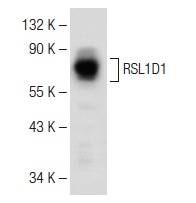
Western blot analysis of RSL1D1 expression in K-562 whole cell lysate.| Product Name | RSL1D1 Antibody (H-280) |
|---|---|
| Antibody Type | Primary Antibodies |
| Antigen Alias | epitope corresponding to amino acids 1-280 mapping at the N-terminus of RSL1D1 of human origin |
| Modification Notes | RSL1D1 (ribosomal L1 domain containing 1), also known as CATX-11 (cellular senescence-inhibited gene protein), PBK1, L12 or CSIG, is a 490 amino acid nuclear protein that belongs to the ribosomal protein L1P family. Expressed in placenta, RSL1D1 contains many phosphorylated amino acid residues and is encoded by a gene that maps to human chromosome 16p13.13. Chromosome 16 encodes over 900 genes in approximately 90 million base pairs, makes up nearly 3% of human cellular DNA and is associated with a variety of genetic disorders. The GAN gene is located on chromosome 16 and, with mutation, may lead to giant axonal neuropathy, a nervous system disorder characterized by increasing malfunction with growth. The rare disorder Rubinstein-Taybi syndrome is also associated with chromosome 16, though through the CREBBP gene which encodes a critical CREB binding protein. Signs of Rubinstein-Taybi include mental retardation and predisposition to tumor growth and white blood cell neoplasias. |
| Clonality | Polyclonal |
|---|---|
| Isotype | IgG |
| Host Species | Rabbit |
| Tested Applications | WBIPIFELISA |
| recommended for detection of RSL1D1 of human and, to a lesser extent, mouse and rat origin by WB, IP, IF and ELISA: |
|
| Species Reactivity | HumanMouseRat |
| Concentration | 1mg/ml |
| Purification | Affinity purified |
| Alternative Names | epitope corresponding to amino acids 1-280 mapping at the N-terminus of RSL1D1 of human origin |
|---|---|
| Tissue Specificity | epitope corresponding to amino acids 1-280 mapping at the N-terminus of RSL1D1 of human origin |
| Entrez Gene | 26156 |
|---|
Application
Western blot analysis of RSL1D1 expression in K-562 whole cell lysate.| Application Notes | recommended for detection of RSL1D1 of human and, to a lesser extent, mouse and rat origin by WB, IP, IF and ELISA: |
|---|
| Form | Liquid |
|---|---|
| Storage Instructions | For short-term storage, store at 4° C. For long-term storage, aliquot and store at -20ºC or below. Avoid multiple freeze-thaw cycles. |
| Storage Buffer | phosphate buffered saline , pH 7.4, 150mM NaCl, 0.02% sodium azide and 50% glycerol. |


