Application
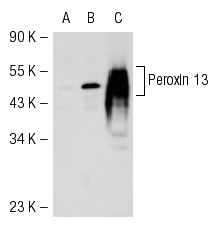
Western blot analysis of Peroxin 13 expression in non-transfected 293T: (A), mouse Peroxin 13 transfected 293T: (B) and H4 (C) whole cell lysates.| Product Name | Peroxin 13 Antibody (H-300) |
|---|---|
| Antibody Type | Primary Antibodies |
| Antigen Alias | epitope corresponding to amino acids 254-403 mapping at the C-terminus of Peroxin 13 of human origin |
| Modification Notes | Peroxisomes are single-membrane bounds organelles present in virtually all eukaryotic cells. They are involved in numerous catabolic and anabolic pathways, including beta-oxidation of very long chain fatty acids, metabolism of hydrogen peroxide, plasmalogen biosynthesis, and bile acid synthesis. The Peroxin gene family, which includes more than 20 members, is required for peroxisome biogenesis. Two members of this family, Peroxin 5 (Pex5) and Peroxin 7 (Pex7), are receptors for proteins that contain the peroxisome targeting signal 1 (PTS1) and 2 (PTS2), respectively, and shuttle these proteins from the cytosol to the peroxisome. Peroxin 5, also designated PTS1 receptor, is expressed as two isoforms, Pex5L and Pex5S. Pex5L transports PTS1 and Pex7-PTS2 cargo complexes to the initial Pex5 docking site, Pex14, while Pex5S transports only PTS1 cargoes. Pex5 and Pex7 also require either direct or indirect interaction with Peroxin 13 (Pex13) for proper import into peroxisomes. Pex13 encodes an SH3-containing peroxisomal membrane protein that binds to sequences lacking a PXXP motif, which includes Pex5. Pex13 has high expression in liver and testis. Pex13 dysfunction is also implicated in some peroxisome biogenesis disorders. |
| Clonality | Polyclonal |
|---|---|
| Isotype | IgG |
| Host Species | Rabbit |
| Tested Applications | WBIPIFELISA |
| recommended for detection of Peroxin 13 of mouse, rat and human origin by WB, IP, IF and ELISA also reactive with additional species, including equine, canine, bovine and porcine: |
|
| Species Reactivity | HumanMouseRat |
| Concentration | 1mg/ml |
| Purification | Affinity purified |
| Alternative Names | epitope corresponding to amino acids 254-403 mapping at the C-terminus of Peroxin 13 of human origin |
|---|---|
| Tissue Specificity | epitope corresponding to amino acids 254-403 mapping at the C-terminus of Peroxin 13 of human origin |
| Entrez Gene | 5194 |
|---|
Application
Western blot analysis of Peroxin 13 expression in non-transfected 293T: (A), mouse Peroxin 13 transfected 293T: (B) and H4 (C) whole cell lysates.| Application Notes | recommended for detection of Peroxin 13 of mouse, rat and human origin by WB, IP, IF and ELISA also reactive with additional species, including equine, canine, bovine and porcine: |
|---|
| Form | Liquid |
|---|---|
| Storage Instructions | For short-term storage, store at 4° C. For long-term storage, aliquot and store at -20ºC or below. Avoid multiple freeze-thaw cycles. |
| Storage Buffer | phosphate buffered saline , pH 7.4, 150mM NaCl, 0.02% sodium azide and 50% glycerol. |


