Application
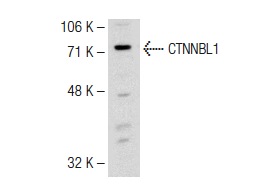
Western blot analysis of CTNNBL1 expression in K-562 nuclear extract.| Product Name | CTNNBL1 Antibody (G-19) |
|---|---|
| Antibody Type | Primary Antibodies |
| Antigen Alias | epitope mapping within an internal region of CTNNBL1 of human origin |
| Modification Notes | CTNNBL1 (catenin, ∫ like 1), also known as NAP (nuclear-associated protein) or P14L, is an evolutionarily conserved protein with structural homology to members of the armadillo family, including ∫-catenin. CTNNBL1 is expressed in a variety of tissues with highest expression levels found in heart, spleen, testis, placenta, thyroid and skeletal muscle. Localizing to the nucleus, CTNNBL1 contains a bipartite nuclear localization signal, an acidic domain, a leucine-isoleucine zipper, an acidic domain and phosphorylation sites. Via its C-terminus, CTNNBL1 is believed to play a role in apoptosis. In addition, multiple SNPs (single nucleotide polymorphisms) in the CTNNBL1 have been associated with fat mass and body mass index (BMI), suggesting a possible role for CTNNBL1 in the development of obesity. |
| Clonality | Polyclonal |
|---|---|
| Isotype | IgG |
| Host Species | Rabbit |
| Tested Applications | WBIPIFELISA |
| recommended for detection of CTNNBL1 of mouse, rat and human origin by WB, IP, IF and ELISA also reactive with additional species, including equine, canine, bovine and porcine: |
|
| Species Reactivity | HumanMouseRat |
| Concentration | 1mg/ml |
| Purification | Affinity purified |
| Alternative Names | epitope mapping within an internal region of CTNNBL1 of human origin |
|---|---|
| Tissue Specificity | epitope mapping within an internal region of CTNNBL1 of human origin |
| Entrez Gene | 56259 |
|---|
Application
Western blot analysis of CTNNBL1 expression in K-562 nuclear extract.| Application Notes | recommended for detection of CTNNBL1 of mouse, rat and human origin by WB, IP, IF and ELISA also reactive with additional species, including equine, canine, bovine and porcine: |
|---|
| Form | Liquid |
|---|---|
| Storage Instructions | For short-term storage, store at 4° C. For long-term storage, aliquot and store at -20ºC or below. Avoid multiple freeze-thaw cycles. |
| Storage Buffer | phosphate buffered saline , pH 7.4, 150mM NaCl, 0.02% sodium azide and 50% glycerol. |


